
Nesykhonsu papyrus – Luxor 2
nsy-xns.w
Ranke I, pg. 178, 20
Also known as Neskhons, Nesikhons, Nesikhonsu, Nesikhonsou, Neschons
Provenance Bab el Gasus, Daressy A.42, see Shabtis
Mistress of the house, Chantress of Amen
This papyrus has been on display on the 1st floor of the Luxor museum since it’s opening in 1975, but has been removed, together with Luxor 1, since 2021 for research into the accelerated decay of the papyrus. See below.
See Mythological Papyri 1957, Piankoff and Rambova Plate 4, for description see page 80-81
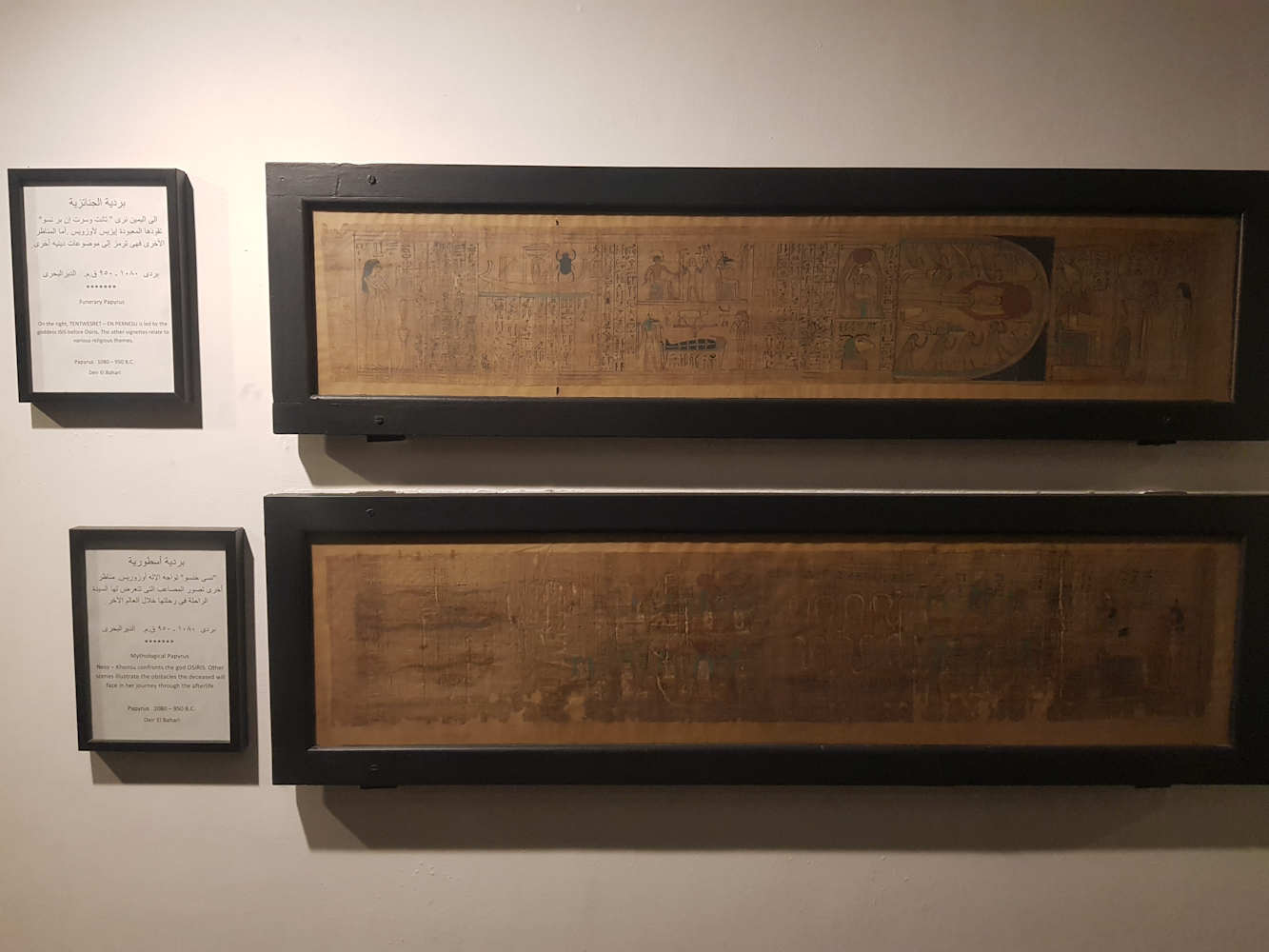
Lower one. Removed in 2021 for research deterioration
Amduat papyrus for Nesykhonsu
Length 124 cm, height 24 cm
Ref. No. S.R.VII.10252, City Museum J.25, Luxor 2, on loan from Cairo Museum, Type A.III.1b Niwinski
Amduat‑derived papyrus integrating selected Book of the Dead motifs into its text and imagery (see Stevens)
Photo and panorama view VB 2021, (quality remarks)
Photo 2021
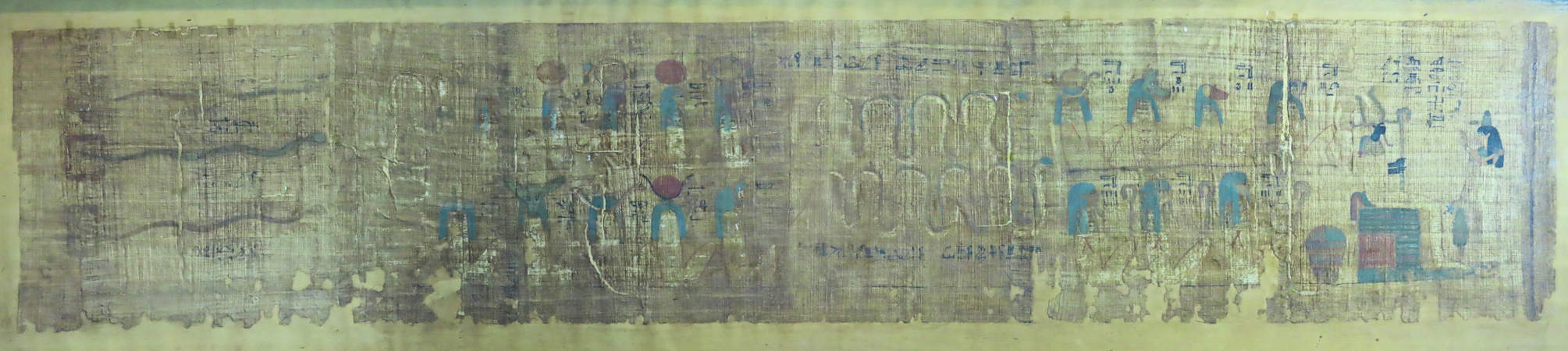
I noticed that this papyrus has been decaying rapidly over the last 50 to 60 years. The Luxor Museum told me (12-2021) to investigate this as soon as possible. For the study of text and drawings it is best to use the panorama shown below compiled of Piankoff’s 1957 photo, Mythological Papyri 1957, © Piankoff and Rambova, Plate 4
Photo Schott Archive, date unknown < 1971
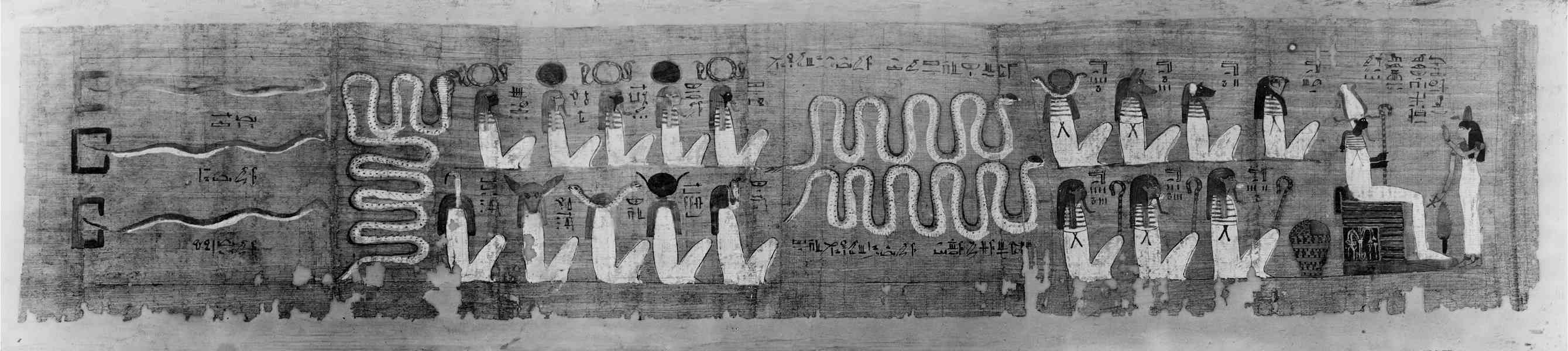
This panorama was created from high resolution scans made from the early 20th century photographs of Prof. Dr. Siegfried Schott. The scans are now stored in the digital Schott archive of the University in Trier, Germany. All images are courtesy © Schott-Archiv, Universitaet Trier, Aegyptology. The high resolution images can be requested at the university
Panorama view VB 2022 (quality remarks)
When comparing Piankoff’s 1957 photograph below with the one in the Schott Archive, it’s notable that the snake in the upper-left corner of Piankoff’s photograph and the wigs on the gods in the middle are depicted much more clearly than in the Schott Archive photograph. Since the photos in the Schott Archive are undated, it’s impossible to determine exactly when they were taken. Given that the professor died in 1971, it appears that the deterioration of the papyrus began sometime between 1957 and 1971, predating the opening of the Luxor Museum. This assumption is based on the premise that Piankoff’s photographs were not enhanced
Photo 1957

Piankoff’s 1957 photo, Mythological Papyri 1957, © Piankoff and Rambova, Plate 4