
The coffins of Pinedjem II
The two coffins (JE 26197 / CG 61029), coffin board, and mummy of Pinedjem II (CG 61094) were discovered in a virtually intact state, supporting the view that DB 320 was likely the original burial place of the Priest-King. His coffins and coffin board exhibit features characteristic of Type YIIIa Twenty-First Dynasty coffins made for males.
The gilded hands are both clenched in a traditionally masculine pose, each holding a sacred object: a djed pillar in the right hand and a tjet knot in the left, symbolising Osiris and Isis respectively. (The djed pillars originally held in the right hands on the outer coffin and mummy board have been broken off, but the base of the djed pillar remains below the clenched right hand of the mummy board, indicating that this was indeed the original item placed there.)
Ears are depicted as part of the face masks and serve as another important gender marker on coffins for males during the Twenty-First Dynasty, as ears are typically not shown on the face masks of female coffins from this period.
The wig is rendered in stripes on the coffin lids and mummy board in the traditional fashion reserved for men’s coffins, and a short square beard adorns the face mask on the mummy cover.
One notable stylistic feature for dating the coffins is highlighted by Ikram and Dodson, who point out that the vignettes of deities are arranged more horizontally across the lower sections of the lids than in earlier Type Y (i.e., “Yellow”) coffins.
Source Bibliography: CCR, p. 95ff.; pls. XLII, XLIII, XLIV; DRN, p. 214, no, 28; p. 256; FP, pp. 207-209; GCSS, pp. 46, 48, 50, 62; MiAE, p. 231, pls. 303-304; p. 330.
Source 2025-07: Edited from a now-defunct page of The Theban Royal Mummy Project via Wayback Machine
Source url: http://anubis4_2000.tripod.com/mummypages1/DB320Coffins/PinudjemIICoffins.htm
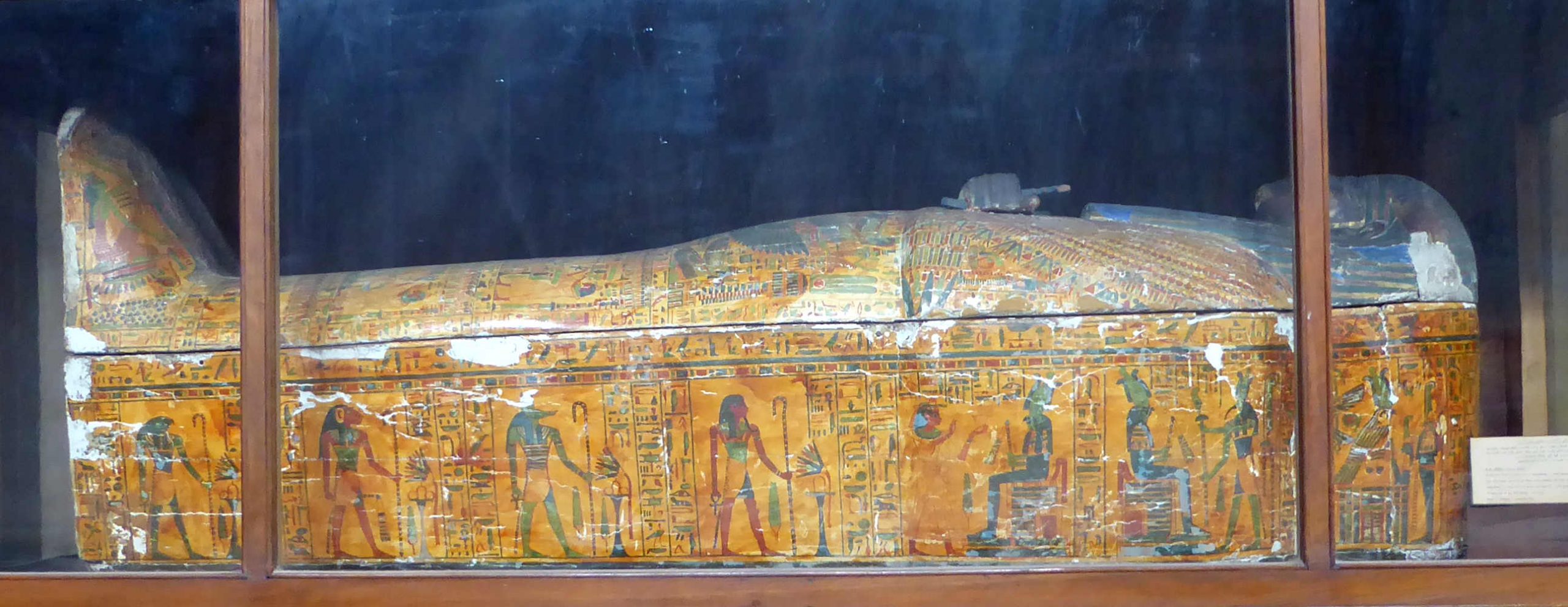
Interior coffin Pinedjem II. Cairo Museum JE 26197 / CG 61029 / SR 10327
Photo: VB 2015

CG 61029
Pinedjem II’s outer and inner coffin lids from Georges Daressy’s Cercueils des cachettes royales, Cairo, 1909

Gilded mummy board Pinedjem II
Photo: VB 2015

Decorative design on inner coffin of Pinedjem II, depicting the Priest-King giving an offering to Anubis
Edited from photo Edward Loring (CESRAS)

CG 61029 Pinedjem II coffins photo VB 2015 001

CG 61029 Pinedjem II coffins photo VB 2015 002

CG 61029 Pinedjem II coffins photo VB 2015 003

CG 61029 Pinedjem II coffins photo VB 2015 004

CG 61029 Pinedjem II coffins photo VB 2015 005

CG 61029 Pinedjem II coffins photo VB 2015 006

CG 61029 Pinedjem II coffins photo VB 2015 007

CG 61029 Pinedjem II coffins photo VB 2015 008

CG 61029 Pinedjem II coffins photo VB 2015 009

CG 61029 Pinedjem II coffins photo VB 2015 010

CG 61029 Pinedjem II coffins photo VB 2015 011

CG 61029 Pinedjem II coffins photo VB 2015 012

CG 61029 Pinedjem II coffins photo VB 2015 013

CG 61029 Pinedjem II coffins photo VB 2015 014

CG 61029 Pinedjem II coffins photo VB 2015 015

CG 61029 Pinedjem II coffins photo VB 2015 016

CG 61029 Pinedjem II coffins photo VB 2015 017

CG 61029 Pinedjem II coffins photo VB 2015 018

CG 61029 Pinedjem II coffins photo VB 2015 019
