
The mummy of Pinedjem I
The mummy of Pinudjem I had been disturbed, probably first in antiquity and then by the Abd er-Rassuls between their discovery of DB 320 and its official clearance by Emil Brugsch 10 years later. The mummy was wrapped in an Osiris shroud, and may have been basically intact but, since its location remains unknown, the condition of the mummy can not be determined. The mummy has no CG number, coffins CG 61025)
The odd fact the mummy of Pinudjem I has been missing since the late 19’th century constitutes a genuine Egyptological mystery. Rumors that it might be at the Qasr el Einy Medical Facility in Cairo occasionally circulate, but nothing definite has ever emerged to confirm this. The photo taken by Brugsch sometime after the DB 320 mummies were taken to Boulak, seems to show a mummy in good condition. The other photo taken by Brugsch shows the mummy as it appeared during an early stage of its unwrapping.
The mummy of Pinudjem I had originally been covered with a shroud held in place with red leather straps, or “braces” (cf. the still-wrapped mummy of Isiemkheb-D.) These had been removed by the Abd er-Rassuls, who attempted to sell them to Charles E. Wilbour, a colleague of Gaston Maspero’s. This event provided important evidence that eventually helped the authorities track down the location of DB 320.
Pinudjem I was interred with an exceptionally fine papyrus copy of The Book of the Dead, which was found rolled up between the legs of his mummy. Two shabti boxes associated with Pinedjem I were also found in the tomb.
Pinudjem I was found in the very large, yellow painted coffin (CG61006) originally belonging to Ahotpe I, mother of Amosis I, the founder of the 18’th Dynasty. But Pinudjem I had originally been buried in a double coffin set (CG61025) that he had appropriated from Tuthmosis I. These two coffins had been coated with plaster, gilded, painted and reinscribed for Pinudjem I. When found, the gilding had been adzed off, but Pinudjem’s inscriptions were left intact. Close inspection of the coffins revealed their original owner. As in the case of Nodjmet’s coffins, Pinudjem I’s had also probably been stripped by priestly reburial officials instead of thieves.
Source Bibliography: CCR, 50ff; DRN, 202, 208, 212, 213; MR, 544ff, 570, 581; MiAE, 92, 125, 230, 232, 319, 329, ills. 73, 74, 128, 129, 207, 301; TVK, 130; XRP, 172, 173.)
Other Burial Data:
Original Burial: Perhaps in the tomb of Inhapi (WN A)
Reburial: after Year 11 of Shoshenq I, in side room “D” of DB 320. Source: DRN, 255
Source: Edited from a now-defunct page of The Theban Royal Mummy Project via Wayback Machine
Source url: https://members.tripod.com/anubis4_2000/mummypages1/21A.htm

No CG number
Pinedjem’s mummy in the Boulaq Museum
Photo: Brugsch
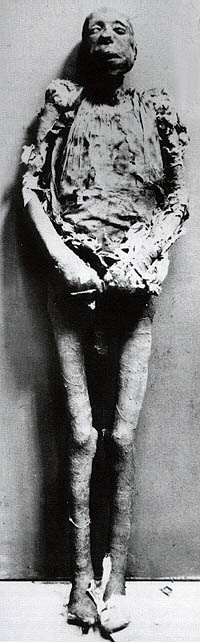
Pinedjem’s mummy in the Boulaq Museum, partly unwrapped
Photo: Brugsch