
The coffins of Isetemkheb D
The outer coffin of Isiemkheb D (CG 61031, mummy CG 61093) was discovered intact, whereas the inner coffin and coffin board had been damaged by thieves who removed the gilded face masks and hands. This pattern, an undisturbed outer coffin concealing evidence that the inner components had been looted, recurs in the double coffin sets of Maatkara, Masaharta, and Nesykhonsu A. Such consistency has led investigators to suspect that the pilfering of these funerary assemblages was carried out by individuals officially involved in their interments, possibly under the guise of legitimate burial activities.
Salima Ikram and Aidan Dodson have theorised that members of Pinedjem II’s burial party were responsible for violating Isiemkheb D’s coffins. However, Edward Loring’s interpretation of a linen docket found on the mummy of Nestanebetisheru suggests that Isetemkheb D was still alive at the time of Pinedjem II’s funeral. If Loring’s dating is correct, the culprits behind the desecration of Isiemkheb D’s funerary equipment would not have been those involved in Pinedjem II’s burial, though the same individuals might still be implicated in the removal of gilded elements from Nesykhonsu’s coffins, which were likely present in DB 320 at the time of Pinedjem II’s interment.
The deliberate effort to conceal the removal of gilded features from Isiemkheb D’s inner coffins indicates that the perpetrators expected subsequent visitors and sought to hide their actions. While priests overseeing the funerary rites have often been blamed for these thefts, it is most plausible that the actual culprits were the workmen responsible for transporting and positioning the heavy coffins within the tomb, who then prepared the scene for the arrival of the officiating priests from whom such damage needed to be concealed.
Isiemkheb D’s coffins also stand apart stylistically from other 21st Dynasty coffins found in DB 320. Unlike the ornately decorated wigs of Nodjemet, Maatkara, Tayuheret and Nesykhonsu A, Isiemkheb D’s wigs are simplified, consisting solely of gold bands on a plain ground. The gold headband on the outer coffin was originally adorned with painted decoration, most of which has now worn away. Plain areas on the wig show traces of earlier decorations which appear to have been carefully removed and expertly covered with black pigment.
The funerary collars exceed the length of those on earlier coffins, extending below the hands; the central panel of the outer coffin is dominated by five registers featuring a winged female deity, probably Nut, which descend to the footboard, while the footboard of the inner coffin is marked by predominantly Osirian motifs. These distinctions point to later developments in the evolution of 21st Dynasty coffin decoration.
Source Bibliography: DRN, 213 no. 18; GCSS, 50, n. 280; 127, Fig. 34; 161, n. 843; MiAE, 330; TRC, 74.
Source 2025-07: Edited from a now-defunct page of The Theban Royal Mummy Project via Wayback Machine
Source url: http://anubis4_2000.tripod.com/mummypages1/DB320Coffins/IsiemkhebCoffins.htm
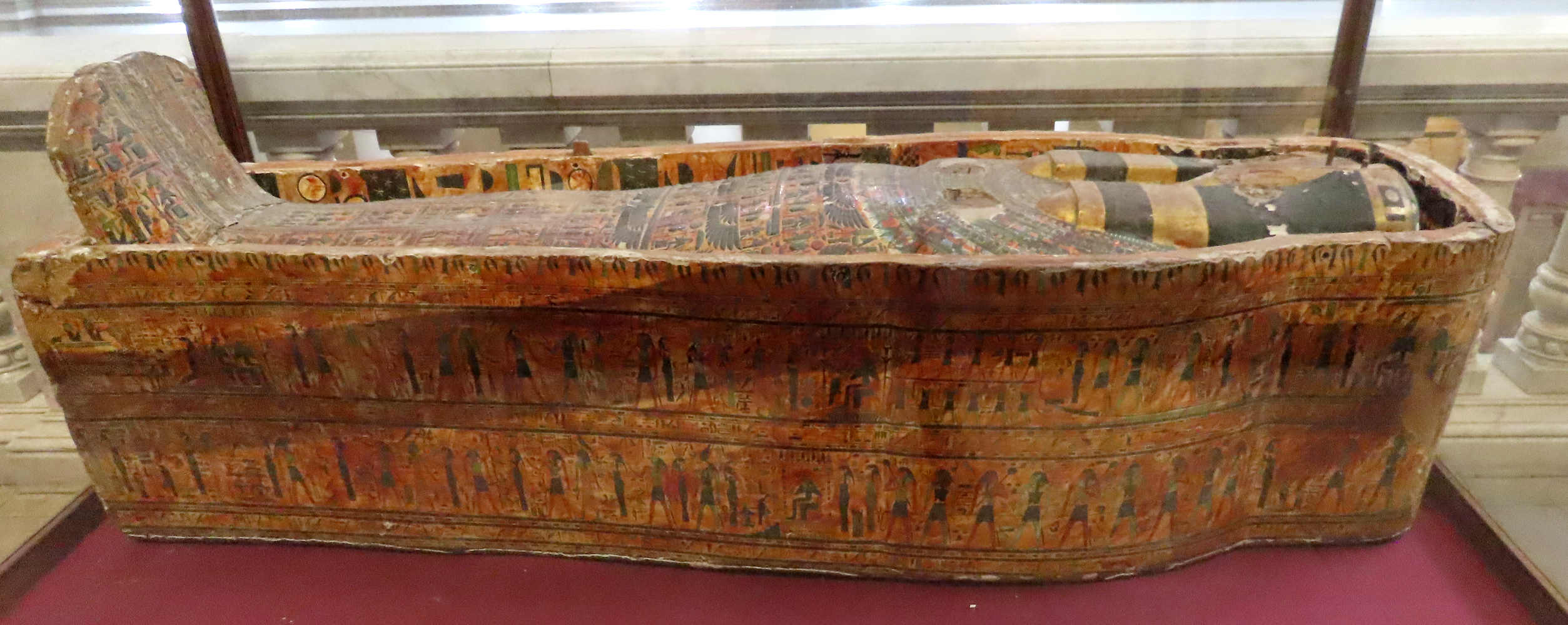
Exterior and interior coffin Isetemkheb D. Cairo Museum JE 26198 / CG 61031
Photo: VB 2020

Outer coffin lid Isetemkheb D, CG 61031
Photo: Denver Museum of Nature & Science?

CG 61031
Isetemkheb’s lid and basin outer coffin from Georges Daressy’s Cercueils des cachettes royales, Cairo, 1909

Isetemkheb’s inner coffin lid and basin from Georges Daressy’s Cercueils des cachettes royales, Cairo, 1909

CG 61031 Isetemkheb D coffins photo VB 2015 001

CG 61031 Isetemkheb D coffins photo VB 2015 002

CG 61031 Isetemkheb D coffins photo VB 2015 003

CG 61031 Isetemkheb D coffins photo VB 2015 004

CG 61031 Isetemkheb D coffins photo VB 2015 005

CG 61031 Isetemkheb D coffins photo VB 2015 006

CG 61031 Isetemkheb D coffins photo VB 2015 007

CG 61031 Isetemkheb D coffins photo VB 2015 008

CG 61031 Isetemkheb D coffins photo VB 2015 009

CG 61031 Isetemkheb D coffins photo VB 2015 010

CG 61031 Isetemkheb D coffins photo VB 2015 011

CG 61031 Isetemkheb D coffins photo VB 2015 012

CG 61031 Isetemkheb D coffins photo VB 2015 013

CG 61031 Isetemkheb D coffins photo VB 2015 014

CG 61031 Isetemkheb D coffins photo VB 2015 015

CG 61031 Isetemkheb D coffins photo VB 2015 016

CG 61031 Isetemkheb D coffins photo VB 2015 017

CG 61031 Isetemkheb D coffins photo VB 2015 018

CG 61031 Isetemkheb D coffins photo VB 2015 019

CG 61031 Isetemkheb D coffins photo VB 2015 020

CG 61031 Isetemkheb D coffins photo VB 2015 021

CG 61031 Isetemkheb D coffins photo VB 2015 022

CG 61031 Isetemkheb D coffins photo VB 2015 023

CG 61031 Isetemkheb D coffins photo VB 2015 024

CG 61031 Isetemkheb D coffins photo VB 2015 025

CG 61031 Isetemkheb D coffins photo VB 2015 026

CG 61031 Isetemkheb D coffins photo VB 2015 027

CG 61031 Isetemkheb D coffins photo VB 2015 028

CG 61031 Isetemkheb D coffins photo VB 2015 029

CG 61031 Isetemkheb D coffins photo VB 2015 030
