
God’s Wives of Amun and their shabtis
July 1, 2026
Under Construction
If the machine translation is confusing, please use the English option 🌈
Search and Filter
| Name | Shabti | Name | Father | Mother | Dyn. | GWA in office | Burial/Cache |
|---|---|---|---|---|---|---|---|
| Ahhotep I | aH-Htp | Seqenenre Tao I | Tetisheri? | 17 | c. 1560 BC | Draʿ Abu el‑Naga cache | |
| Ahmose-Nefertari | aH-ms-nfr-t3-ri | Seqenenre Tao II | Ahhotep I | 18 | c. 1540 BC | DB 320 cache | |
| Ahmose | aH-ms-st-kA-ms | Kamose? | Ahhoptep II? | 18 | c. 1540 BC | unknown | |
| Ahmose-Meritamun | aH-ms-mri.t-imn | Ahmose I | Ahmose-Nefertari | 18 | c. 1530 BC | TT 358 | |
| Ahmose-Sitamun | aH-ms-st-imn | Ahmose I | Ahmose-Nefertari | 18 | c. 1525 BC | DB 320 cache | |
| Hatshepsut | Hat-Spswt | Thutmose I | Ahmose | 18 | c. 1500 BC | KV 20 - KV60 cache? | |
| Neferure | nfr-wA-ra | Thutmose II | Hatshepsut | 18 | c. 1485 BC | Wadi C-1 | |
| Iset (queen) | As.t | Thutmose I? | unknown | 18 | c. 1470 BC | unknown | |
| Satiah | As.t-iAH | Ahmose Pen‑Nekhebet? | Ipu? | 18 | c. 1465 BC | unknown | |
| Merytre-Hatshepsut | mri.t-ra-Hat-Spswt | unknown | Huy | 18 | c. 1455 BC | KV 42? | |
| Meritamen C | mri.t-imn | Thutmose III | Merytre-Hatshepsut | 18 | c. 1445 BC | unknown | |
| Tiaa | tiAa | unknown | unknown | 18 | c. 1400 BC | KV 32? | |
| No GWA | no | - | - | - | 18-19 | c. 1360 BC - 100 yrs | - |
| Sitre | sAi.t-ra | unknown | unknown | 19 | c. 1290 BC | unknown | |
| (Mut-)Tuy | twi - mwt-twi | unknown | unknown | 19 | c. 1280 BC | unknown | |
| Tausret | no | twA-wsr.t | Merenptah? | Tachat? | 19 | c. 1190 BC | KV 14 |
| Iset Ta-Hemdjert | yes | As.t tA-Hmdirt | unknown | Hemedjert? | 20 | c. 1180 BC - 0-? Yrs | QV 51 |
| Tyti | no | ti.ti | Ramses III? | unknown | 20 | c. 1170 BC - 15-31 yrs | QV 52 |
| Duatentopet | no | dwAt-n-ip(.t) | Ramesses III? | Iset Ta‑Hemdjert? | 20 | c. 1150 BC - 15-20 yrs | QV 74 |
| Iset | yes | As.t | Ramesses VI | Nubkhesbed | 20 | c. 1140 BC - 20-30 yrs | unknown |
| No GWA | no | - | - | - | 20-21 | c. 1080 BC - 110 yrs | - |
| Maatkara | yes | mAa.t-kA-ra | Pinedjem I | Henuttawy A | 21 | c. 1035 BC - 40-55 yrs | DB 320 cache |
| unknown (hypothetical) | no | - | - | - | 21 | c. 1000 BC - 0-? yrs | unknown |
| Henuttawy D | yes | Hnw.t-tA.wy | Pinedjem II | Isetemkheb D? | 21–22 | c. 960 BC - 0-10? yrs | Thebes |
| Mehytweskhet D | yes | mHyt-wsx.t | Sheshonq I | - | 22 | c. 940 BC - 3-10 yrs | Thebes Pit 1103 |
| No GWA | no | - | - | - | 22 | c. 880 BC - 60-90? yrs | - |
| Karomama G | yes | kAr-ma-ma | Osorkon II? | Karoma B? | 22 | c. 830 BC - 25-40 yrs | Ramesseum |
| Qedmerut | yes | qd-mrw.t | Osorkon II? | - | 22 | c. 800 BC - 0-? yrs | Ramesseum |
| Tashakheper A | no | tA-SA-xpr | - | - | 22-23 | c. 760 BC - 0-? yrs | unknown |
| Shepenwepet I | ? | Spn-wpt | Osorkon III | poss. Karomama II | 23 | c. 740 BC - 20-30 yrs | Medinet Habu? (fc) |
| Amenirdis I | yes | imn-ir-dis | Kashta | Pabatma | 25 | c. 730 BC - 10-20 yrs | Medinet Habu |
| Shepenwepet II | yes | Spn-wpt | Piye (Piankhi) | - | 25 | c. 680 BC - 50-60 yrs | Medinet Habu |
| Amenirdis II | no | imn-ir-dis | Taharqa | - | 25 | c. 655 BC - 0 yrs | Medinet Habu |
| Nitocris I | yes | nt-iqrt | Psamtik I | Mehetenweskhet | 26 | c. 620 BC - 30-55 yrs | Medinet Habu |
| Ankhnesneferibre | no | anx-n.s-nfr-ib-ra | Psamtik II | Takhat | 26 | c. 560 BC - 61 yrs | Medinet Habu |
| Nitocris II | no | nt-iqrt | Amasis II | - | 26 | c. 530 BC - 0 yrs | Medinet Habu |
Remarks on the table above
In the table I have included the God’s Wives cited in various publications on these remarkable and often powerful women. I have also included women who were designated for the office (designated heirs) but may never actually have served. Two such cases are Amenirdis II and Nitocris II from the 25th and 26th Dynasties
There is an ongoing debate about their precise titles and periods in office. For example, Ahhotep I held the title “God’s Wife” rather than “God’s Wife of Amun”, yet she is generally regarded as the first in the sequence presented here
The weight of the office also varied considerably. Maatkara Mutemhat was the first to wield substantial power, and she assumed all the associated titles linked to the office of God’s Wife of Amun, such as “God’s Hand” and “Divine Adoratrice”. From the time of Maatkara onwards, the holders of the office are generally considered to have lived in ritual celibacy, although the exact extent and timing of this requirement remains a matter of scholarly debate
On most of the shabtis known for these God’s Wives the inscription “Duat Netjer” dwAt-nTr, appears before the cartouche, which is understood as “Divine Adoratrice”
God’s Wives of Amun
The God’s Wives of Amun were among the most powerful women ever to hold religious office in ancient Egypt. Serving as the chief priestesses of Amun at Thebes, they stood at a unique intersection of kingship, cult, and economy. From their New Kingdom beginnings as royal consorts with a prestigious ritual title, the office evolved into a quasi‑royal institution in its own right: God’s Wives bore throne names in cartouches, adopted heirs, controlled estates, and could rival high officials in wealth and influence
By the Third Intermediate Period, the God’s Wife of Amun was no longer simply the king’s wife, but a royal daughter dedicated to the god, expected (at least in theory) to live in ritual celibacy and to embody Amun’s divine consort in Thebes. Through carefully staged adoptions, Libyan, Kushite, and Saite rulers used these women to legitimise new dynasties and to negotiate control over Upper Egypt without open conflict. In temple reliefs they appear almost as female counterparts of the king: wearing tall plumed crowns, accompanied by elaborate titulary, and performing key rites at Karnak
At the same time, their identity remained deeply personal and often fragile. Many of these women are known to us only from funerary equipment, scattered ushebtis, or damaged inscriptions, leaving modern scholars to reconstruct their careers from fragmentary evidence. The God’s Wives of Amun are therefore fascinating not only because they represent an extraordinary experiment in female religious authority, but also because they allow us to watch, in miniature, how power, piety, and family politics were continuously renegotiated in the last great centuries of pharaonic Thebes
Relevant publications
Karomama Revisited
by Claus Jurman (2016)
Meike Becker, Anke Blombaum, Angelika Lohwasser,
Prayer and Power: Proceedings of the Conference about the God’s Wives of Amun in Egypt during the First Millennium BC, Ägypten und Altes Testament 84 (Ugarit-Verlag, Münster), 61–88
The God’s Wife of Amun
by Mariam F. Ayad (2020)
Origins and rise to power
The shabtis of the Gods’ Wife of Amun and Divine Adoratrice Mehyt-Weskhet
by Niek de Haan (2020)
Fragmento anónimo de un ushebti de una Divina Adoratriz de Amón, de la Dinastía XXII
by José Mª Ortuondo Rocandio (2008)
King’s Daughter, God’s Wife: The Princess as High Priestess in Mesopotamia and Egypt
by Lloyd D. Graham (2017)
Das Gottesweib des Amun
C.E. Sander-Hansen (1940)
The God’s Wife of Amun (Dynasty 23-26): Rise to Power & Assumption of the Priesthood
by Mariam Ayad (2021)
Property and the God’s Wives of Amun
by M.C. Bryan (200x)
Celibacy and Adoption among God’s Wives of Amun and Singers in the Temple of Amun: a Re-examination of the Evidence
by Emily Teeter (1999)
The Excavation of Medinet Habu, Volume IV
The Mortuary Temple of Ramses III. Part II
by Uvo Hölscher with contributions by Rudolf Anthes (1951)
The Excavation of Medinet Habu, Volume V
Post‑Ramessid Remains
by Uvo Hölscher
Le clergé féminin d’Amon thébain à la 21e dynastie
S. Naguib (1990)
God’s Wife, God’s Servant
The God’s Wife of Amun (ca.740–525 BC)
by Mariam F. Ayad (2009)
Les Divines épouses d’Amon dans l’Égypte de la 19e à la 21e dynastie
by Luc Gosselin (2007)
Study on the symbolism and the evolution of the role of the Divine Adoratrices of Amun from the 19th to the 21st Dynasty
De la mère du roi àl’épouse du dieu /
Von der Königsmutter zur Gottesgemahlin
by Claude Obsomer and Jannik Korte (2017)
Preliminary synthesis of the results of the excavations of the Temple of Tuya and the Tomb of Karomama

Statue Quedmerut
22nd Dynasty, c. 800 BC
Bronze, gold, silver, electrum, 59 cm
Louvre Inv. N 500 ; CC 243 ; Champollion n°52
Catalogue shabtis of the God’s Wives of Amun
Iset Ta-Hemdjert – As.t tA-Hmdirt
Also known as Isis Ta-Hemdjert, Aset Ta-Hemdjert, Aset Ta-Hemdyert, Iset Ta-Chemdjert
Is generally regarded as being of Asiatic (Syrian) origin
c. 1180 BC
A distinct group of unprovenanced shabtis bearing the name Aset (Iset) is traditionally associated with the Queen, largely because they feature a princess-like side-lock of youth worn over a short wig. Crucially, these figurines lack a royal uraeus (cobra) on the brow and are inscribed with a vertical register containing her title Hm.t nsw (King’s Wife) alongside her name enclosed in a royal cartouche
As Schiaparelli’s 1924 excavation report of her heavily plundered tomb (QV51) yielded no trace of her original funerary figurines, recording only fragments of her granite sarcophagus, these shabtis lack an archaeological context. It is widely accepted that they were deposited as cenotaph or votive offerings at Abydos. This ritual practice was believed to allow the deceased queen’s Ba to be magically present in the pilgrimage center of Osiris, ensuring her participation in the god’s eternal cycle of rebirth
While earlier studies understandably grouped these shabtis with the distinctive wig and side-lock together due to their very similar execution, in my view, a compelling stylistic analysis demands a dual-generation division. Beyond the iconographic presence of the royal cobra, the shabtis of the granddaughter (the God’s Wife of Amun) are more slender in posture compared to the more robust execution of her grandmother’s figurines, and are executed with horizontal registers
As a regular queen consort who did not hold active sovereign authority during her lifetime, Queen Iset had no inherent political justification to disrupt traditional funerary iconography with a uraeus. Consequently, she is the rightful owner of this more conventional, wider non-cobra typology, strictly differentiating her figurines from the revolutionary shabtis proposed by me to belong to her granddaughter’s pharaonic office.
You can read the full theory in my analysis here
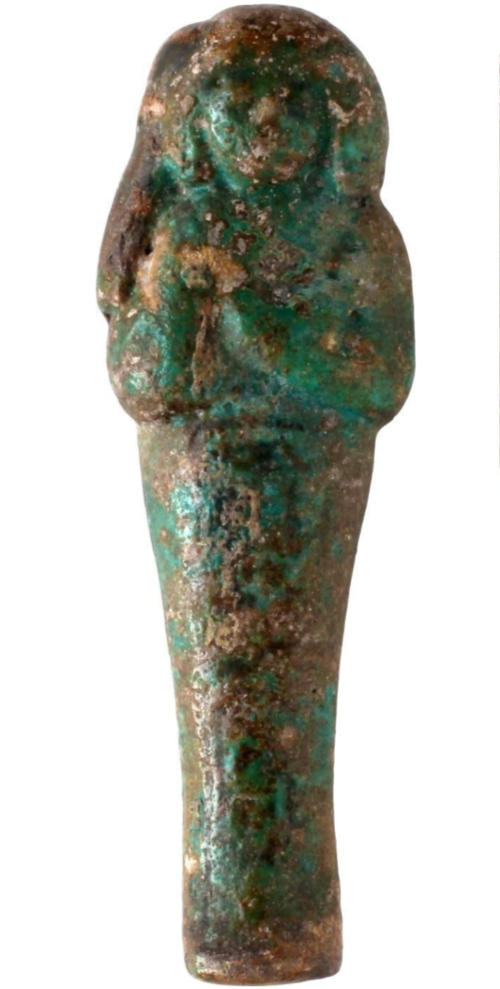
Iset Ta-Hemdjert – As.t tA-Hmdirt
Worker, 16 cm
Type 1 (arms left over right)
Text in one vertical register: wsir Hm.t nsw (As.t)
Faience
Most likely MMA Inv.no. 17.194.2344 (Janes) – not found in MET database
See also the photos of the side and back here
Erroneously dated by the museum to the 12th Dynasty. The museum also mentions with this object (2026-06) “Originally catalogued as a modern forgery, this object may be authentic, but represents an unusual form.”
For a detailed description with references, see The Shabti Collections No. 5 by Glenn Janes, pg. 13-14
Photo: website Manchester Museum
Here on photo 2012, courtesy Niek de Haan listed as Queen Ese
Glenn Janes, who has been tremendously helpful to me, pointed out that there are in fact two types of this shabti: one with the arms crossed left over right, and another with the arms crossed the other way around

Iset Ta-Hemdjert – As.t tA-Hmdirt
Worker, 15.6 cm
Type 2 (arms right over left)
Text in one vertical register: illegable
Faience
RMO Leiden Inv. F1993/10.1
Photo: website RMO
Similar examples in Aubert 1974 Pl. 40 and Newberry 1957 Pl. XXXIII
Iset – As.t
Also known as Isis, Aset
Belonged to the Egyptian royal family
c. 1140 BC
This rare shabti likely depicts Princess Aset (Iset), daughter of Pharaoh Rames VI. Appointed by her father to the revived office of God’s Wife of Amun, Aset was placed at the head of the powerful priesthood in Thebes to secure royal influence over the region
Remarkably, she became the first holder of this title decreed to live in lifelong celibacy, establishing a powerful new tradition of independent, unmarried priestesses who ruled the vast estates of the god Amun
The extraordinary status she achieved during her lifetime is directly reflected on this shabti. While standard shabtis depict ordinary afterlife servants, Aset’s figurine breaks tradition by prominently featuring the royal uraeus, the rearing cobra, upon her brow. Typically reserved for reigning monarchs and great queens, the presence of the uraeus on this shabti underscores Aset’s unprecedented, quasi-royal authority and sovereign independence, which she carried with her into eternity.
Note: While scholarly consensus generally attributes this cobra-bearing type of shabti to her grandmother, Queen Aset Ta-Hemdjert, this remains highly unlikely. The Queen is already associated with standard shabtis inscribed with the basic title Hm.t nsw (King’s Wife) and lacking a uraeus. Her political status did not grant her pharaonic authority, making the inclusion of a royal cobra on her funerary figurines highly improbable
Although the inscriptions on all shabtis I have seen of this specific type remain illegible, preventing absolute proof, the attribution to the God’s Wife Aset remains the most logical and historically consistent conclusion
You can read the full theory in my analysis here.

Iset – As.t
Worker, c. 17.1 cm (around 10% taller than her grandmother)
Text in eight or nine horizontal registers: illegible for now (2026-06)
Faience
Most likely Inv.no. O.C.885, Gallery 122, no image
Metropolitan Museum, New York
Photo: VB 2007
Next to her grandmother on the left, photo courtesy Niek de Haan 2012

See here for a worker shown from all sides
Photo courtesy Glenn Janes
Maatkara – mAa.t-kA-ra
Also known as Maatkara, Maatkare, Makeri, Mutemhat, Mutemhet, Kamara, Maatkare-Mutemhet, Maatkara-Mutemhat
Belonged to the Theban royal and high‑priestly family
c. 1035 BC
Maatkare-Mutemhat was the daughter of the High Priest–King Pinedjem I and one of the most powerful women of Egypt’s Twenty-first Dynasty. Holding the exalted titles of Divine Adoratrice and God’s Wife of Amun, she combined the highest priestly offices of the Theban Amun cult in her person, giving her exceptional influence over both temple ritual and the political life of Upper Egypt
In a period when royal authority was divided between the northern capital at Tanis and the southern power-base at Thebes, Maatkare served as a key intermediary, embodying the close alliance between crown, priesthood and family. Her importance is further underlined by the care taken with her burial: her mummy was rewrapped and reinterred in the Royal Cache at Deir el-Bahri (DB 320), alongside kings and leading members of the Theban elite, to protect them from tomb robbery in the later Third Intermediate Period
Her shabtis, distinguished by the presence of a uraeus and a royal cartouche, visually emphasise her elevated, almost royal status within this Theban priestly milieu

Maatkara – mAa.t-kA-ra
Worker, 11.5 cm
Faience
Dutch private collection
Photo: VB 2012
See here for different workers and overseers for this lady

Maatkara – mAa.t-kA-ra
Overseer, c.12 cm
Faience
Cairo Museum
Photo: courtesy Edward Loring
Henuttawy D – Hnw.t-tA.wy
Also known as Henouttaouy, Henuttaui, Henettawy, Henouttawy, Honittaoui
Belonged to Theban high-priestly/royal elite
960 BC
Henuttawy D, like several of her female relatives, held the foremost sacral offices available to a woman. As God’s Wife of Amun and Divine Adoratrice, she occupied a pivotal position at the apex of the Theban Amun priesthood, mediating between temple, throne and family in the politically fragmented landscape of the Third Intermediate Period
Her shabtis, finely modelled and carefully personalised, participate in the same iconographic tradition as those of other God’s Wives of Amun of the period, yet they diverge in one striking respect: unlike most of her counterparts, and with the exception of her successor Mehytweskhet D, Henuttawy D is not shown wearing a uraeus on her brow. Whereas the royal serpent on the shabtis of other God’s Wives in the Third Intermediate Period underscores their quasi‑royal standing, the absence of the uraeus marks her figures as iconographically exceptional and suggests a more nuanced, consciously restrained articulation of female sacral power within the Theban priestly milieu

Henuttawy D – Hnw.t-tA.wy
Worker, c. 16.7 cm
Faience
Inv. no. EA 15673
Photo: © The Trustees of the British Museum

Henuttawy D – Hnw.t-tA.wy
Overseer, c. 15.7 cm
Faience
Inv. no. EA 65803
Photo: © The Trustees of the British Museum
Mehytweskhet D – mHyt-wsx.t
Also known as Mehytweskhet Meretmut. Mehetenweskhet
Belonged to the Libyan–Egyptian royal family
c. 940 BC
Known almost exclusively through her exceptionally fine shabtis. Her worker shabtis are predominantly of bright cobalt‑blue faience, mummiform, with a finely striated tripartite wig and seshed‑headband with long streamers, holding two hoes across the chest and carrying a seed bag on the back; a smaller group of overseer figures shows a shorter wig, whip, the dress of the living, and a partial back‑pillar on a pedestal, an unusually early feature for this period
Several shabtis, including pieces now in Cairo and the Louvre, have traditionally been associated in the literature with the priestly cemetery at the Ramesseum, where Petrie and Quibell uncovered a 22nd–25th Dynasty necropolis in 1896, but this link is incorrect: Quibell’s Ramesseum report does not mention Mehyt‑Weskhet anywhere, neither in the name lists of shabtis nor in the published photograph of the shabtis found at the site, so the supposed connection with the Ramesseum rests entirely on later shabti studies
Excavations by Winlock at Deir el‑Bahri, on the other hand, show that several shabtis of Mehytweskhet were recovered from “Pit 1103,” a reused 11th‑Dynasty tomb with a heavily disturbed context and material ranging from the Middle Kingdom to the Ptolemaic Period. The presence of her shabtis there is certain, but whether this represents her original burial or a secondary deposition remains unclear. For a detailed discussion and known shabtis, see a study by Niek de Haan

Mehytweskhet D – mHyt-wsx.t
Worker, 17 cm
Faience
Inv. no. E 1976 – N 2249
Photo: © 2018 Musée du Louvre

Mehytweskhet D – mHyt-wsx.t
Overseer, 16.5 cm
Faience
Inv. no. E 5334
Photo: © 2002 Musée du Louvre
Karomama G – kAr-ma-ma
Also known as Karomama Meritmut, Karomama Mérytmout
Belonged to the Libyan–Egyptian royal family
c. 830 BC
Primarily known through a group of ushabtis linked to the Ramesseum at Thebes. Her tomb, rediscovered in 2014 beneath the floor of a chapel north of the so‑called “Temple of Tuya” within the Ramesseum complex, yielded numerous fragments of ushabtis that match pieces acquired in the 19th century from the same area
The ushabtis display characteristic 22nd‑Dynasty Libyan features, bag‑shaped wig and frontal uraeus
Ushabtis of Karomama are now dispersed across several private and museum collections, including a substantial series in Berlin, examples in Cairo, an overseer figure in the Louvre, and a worker figure in the British Museum
Sixty-nine worker shabtis and ten overseers in museum and private collections are identified in “De la mère du roi à l’épouse du dieu / Von der Königsmutter zur Gottesgemahlin” by Claude Obsomer and Jannik Korte (2017)

Karomama G – kAr-ma-ma
Worker, 14.3 cm
Faience
Inv. no. EA 74324
Photo: © The Trustees of the British Museum

Karomama G – kAr-ma-ma
Overseer, 14.4 cm
Faience
Inv. no. E 5335
Photo: © 2011 Musée du Louvre
Qedmerut – qd-mrw.t
Also known as Ked-meret, Kedmeret, Kedmerut, Quedmerut
Belonged probably also to the Libyan–Egyptian royal family
c. 800 BC
In contrast to her successor Karomama, whose tomb was rediscovered in 2014 in the northern temple of Tuya at the Ramesseum, the tomb of Qedmerut has not yet been identified
The shabtis are made of faience, pale blue in colour with hieroglyphic inscriptions in black paint, and are approximately 98 mm in height. They depict her in mummiform wearing a uraeus (cobra) on her forehead
Three examples, most likely discovered by James Edward Quibell in 1898 at the Ramesseum, are now kept in Liverpool. Although they are not mentioned in the excavation report, a photo of one of them is included in the published plates. The reverse of these shabtis is illustrated in “The Shabti Collections 6″ by Glenn Janes
Forty worker shabtis in museum and private collections are described in “De la mère du roi à l’épouse du dieu / Von der Königsmutter zur Gottesgemahlin” by Claude Obsomer and Jannik Korte (2017)
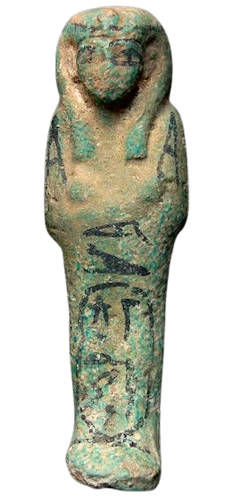
Qedmerut – qd-mrw.t
Worker, 10 cm
Faience
Inv. no. EA 71294
Photo: © The Trustees of the British Museum
See the Global Shabti Project for the complete series.

Qedmerut – qd-mrw.t
Proposed overseer, 8.8 cm
Faience
Inv. no. E14685
Photo: courtesy Penn Museum
Glenn Janes drew my attention to a possible overseer belonging to this series. Two overseers with a uraeus are known, both found in the Ramesseum, the same location as the workers
Since the uraeus is almost exclusively associated with very high‑ranking individuals, such as the God’s Wives of this period, it is logical to link this overseer to the series of the God’s Wife Qedmerut. Glenn Janes was the first to propose this connection. Egyptologist Ken Griffin, curator of Swansea University’s Egypt Centre and an expert on her shabtis, added them to his database and wrote about them on the Global Shabti Project. The overseer seems to show the curved outline of a cartouche above the mr‑sign; if this is correct, the identification is certain. Although no title is preserved on this shabti, which would have removed all doubt, I am convinced this is the most plausible interpretation and therefore include it here.
See the Global Shabti Project for the complete series.
Amenirdis I – imn-ir-dis
Also known as Amunirdis, Imenirdis, Amenirdis, Amenardis, Ameniritis
Belonged to the Kushite royal family
c. 730 BC
Amenirdis I is represented by shabtis found in the Theban burial chapels of the God’s Wives of Amun, in the wider Medinet Habu area on the West Bank at Thebes. These finely made figurines of hard stone depict her as a mummiform figure with crossed arms holding agricultural tools and a royal uraeus on her wig, and they carry short versions of the Chapter 6 shabti spell naming her as God’s Wife of Amun and sister of King Shabaka
Most of this material was brought to light in the 20th century by archaeological missions working on the temples and cemeteries of western Thebes, notably the Chicago expedition of the Oriental Institute (now ISAC) at Medinet Habu and related Theban sites, and later Franco‑Egyptian work on the chapels and tombs of the God’s Wives of Amun
Earlier, in the 19th and early 20th centuries, individual shabtis and fragments bearing her name had already entered museum collections through dealers and private collections

Amenirdis I – imn-ir-dis
Worker, 22.1 cm
Serpentine
Oriental Institue, Chicago E14198
Photo: VB
See the Global Shabti Project for the complete series.
Shepenwepet II – Spn-wpt
Also known as Shepenupet, Chepenoupet, Chepenupet
Belonged to the Kushite royal family
c. 680 BC
Shepenwepet II was one of the most powerful women of the late Kushite–Saite era, serving as God’s Wife of Amun in Thebes with vast economic, religious, and political authority that even Psamtek I had to acknowledge through the famous Adoption Stela, by which his daughter Nitocris was incorporated into her line
A daughter of King Piye (Piankhi) and sister of the Kushite pharaoh Taharqa of the 25th Dynasty, she held the highest Theban priestly office, controlling extensive estates, personnel, and revenues
In practice she acted as a female co‑ruler in Upper Egypt, performing rituals as the king’s counterpart and commissioning her own stelae, temple decorations, and administrative decrees
Within the Amun priesthood she was pivotal in the transition from Nubian to Saite rule: by formally adopting Nitocris under Psamtek I, she allowed the new dynasty to secure the immense Theban cult properties without removing her from office
Statues and inscriptions from sites such as Karnak and Medinet Habu show her in elaborate priestly dress, underlining her status as one of the most influential religious figures of the 7th century BC

Shepenwepet II – Spn-wpt
Worker combined Cairo/Chigaco, c. 16 cm
Serpentine Cairo black, Chigaco brown
The fragments do not belong together. The present arrangement merely suggests how the original shabti may have looked, as no complete examples are known
Photo: Excavation report 1954, Plate 21-D, text:
“There is a ushabti of greenish-black serpentine, approximately 16 cm high (e.g. Pl. 21 D [Cairo J 59724 + Chicago 14192] and E), mostly fragmentary, found in the “tank” and in Tomb 3 (see p. 30), for example Cairo J 59724–25 and Chicago 14191–97.”
British Museum EA65806
– holding royal crook and flail
Louvre E 11159
-holding hoe in left hand?
Oriental Institue E14191
– holding two hoes
– wrongly attributed to Diesehebsed
Petrie Mueum LDUCE-UC40089
– (rope?) in left hand parallel at wig
Cairo JE 59724
– holding two hoes
Dutch private collection
– holding two hoes
See the Global Shabti Project for the complete series.

Shepenwepet II – Spn-wpt
Worker, 7.7 cm
Faience
Oriental Institue, Chicago E15616
Photo: The Global Shabti Project. I believe that this group is for Shepenwepet II and has been incorrectly attributed to Shepenwepet I, see here)

On the right the 5 faience shabtis (G) 8 cm in Chigaco in the style of the shabtis of her father Piye (Piankhi)
In the 1954 excavation report the following items are attributed to Shepenwepet II
“Twenty ushabtis of greenish faience bearing the name of Shepenupet II, 8 cm high (see e.g. Pl. 21 G⁸), are recorded, for example Chicago 15615–20, together with one overseer of greenish faience, uninscribed, 7 cm high (Pl. 21 G, extreme left; Chicago 15635).
The report also mentions twenty-three uninscribed ushabtis of greenish faience, approximately 12 cm high (see e.g. Pl. 21 H⁸; e.g. Chicago 15597, 15599, 15693), and five overseers of greenish faience, uninscribed, 12–13 cm high (see e.g. Pl. 21 H⁸; e.g. Chicago 15598, 15600, 15694).”
Nitocris I – nt-iqrt
Also known as Nitokris, Nitiqret
Belonged to the Saite Egyptian royal family
c. 620 BC
Nitocris I, daughter of Psamtek I, was installed as God’s Wife of Amun to secure Saite political and religious control over Thebes through a carefully choreographed adoption ritual in 656 BC that replaced the Kushite line of god’s wives with a royal princess from Sais. The Nitocris Adoption Stela from Karnak records her formal adoption by the incumbent God’s Wife Shepenwepet II and the displacement of Amenirdis II, presenting Nitocris as the divinely endorsed heiress to Amun’s vast temple estates and thereby legitimizing the Saite dynasty’s authority in Upper Egypt
Her period of office as God’s Wife of Amun spanned almost 70 years, from her arrival in Thebes in 656 BC until her death around 585 BC
Excavations at Medinet Habu have yielded about 24 ushabtis of grey‑green faience, approximately 15 cm high. Twelve of these are complete (e.g. Pl. 21 F¹ [Cairo J 59709 and Chicago 14096]). Found in the “tank.” Cairo J 59707–11 and Chicago 14093–14105, 14107–41.
Also they found ushabtis of greenish fayence, ca. 8 cm. high, inscribed with “Nitocris.” Found near the “tank.” Near them were 2 uninscribed ushabtis of the overseer type, 7 cm. high. The current whereabouts are unknown

Nitocris I – nt-iqrt
Worker, 17.4 cm
Faience
Oriental Institue, Chicago E14094A-B
Photo: Oriental Institue
There are two types: one of c. 17.4 cm with only horizontal registers and cartouches in the upper two registers, and one of c. 14.4 cm with a single central vertical register
The original colour of the shabtis was light blue. The later discolouration to green and eventually brown is caused by oxidation under the influence of moisture and light

Nitocris I – nt-iqrt
Worker, c. 14.4 cm
Faience
Cairo no. in cabinet 7689
Photo: VB 2015
Here an example with a vertical register and a cartouche on the front, also in Chicago, E14098A-B, 14.4 cm. Photo: VB 2007
Here in the Petrie Museum a nice green example