
Book of the Dead Spells and their Vignettes
1-16 - Burial, Emergence | ||||
|---|---|---|---|---|
and Solar Worship | ||||
| 1 | 1b | 2 | 3 | 4 |
| 5 | 6 | 7 | 8 | 9 |
| 10 | 11 | 12 | 13 | 14 |
| 15 | 16 | |||
17 - 63 - Divine Knowledge, | ||||
Restoration and Protection | ||||
| 17 | 18 | 19 | 20 | 21 |
| 22 | 23 | 24 | 25 | 26 |
| 27 | 28 | 29 | 29a | 29b |
| 30 | 30a | 30b | 31 | 32 |
| 33 | 34 | 35 | 36 | 37 |
| 38 | 38a | 38b | 39 | 40 |
| 41 | 41b | 42 | 43 | 44 |
| 45 | 46 | 47 | 48 | 49 |
| 50 | 51 | 52 | 53 | 54 |
| 55 | 56 | 57 | 58 | 59 |
| 60 | 61 | 62 | 63a | 63b |
64 - 129 - Going Forth, | ||||
Transfromation and | ||||
Divine Admission | ||||
| 64 | 65 | 66 | 67 | 68 |
| 69 | 70 | 71 | 72 | 73 |
| 74 | 75 | 76 | 77 | 78 |
| 79 | 80 | 81 | 82 | 83 |
| 84 | 85 | 86 | 87 | 88 |
| 89 | 90 | 91 | 92 | 93 |
| 94 | 95 | 96 | 97 | 98 |
| 99 | 100 | 101 | 102 | 103 |
| 104 | 105 | 106 | 107 | 108 |
| 109 | 110 | 111 | 112 | 113 |
| 114 | 115 | 116 | 117 | 118 |
| 119 | 120 | 121 | 122 | 123 |
| 124 | 125 | 126 | 127 | 128 |
| 129 | ||||
130 -162 - Solar Renewal, | ||||
Sacred Topography and | ||||
Funerary Protection | ||||
| 130 | 131 | 132 | 133 | 134 |
| 135 | 136a | 136b | 137a | 137b |
| 138 | 139 | 140 | 141 | 142 |
| 143 | 144 | 145 | 146 | 147 |
| 148 | 149 | 150 | 151 | 152 |
| 153 | 153a | 153b | 154 | 155 |
| 156 | 157 | 158 | 159 | 160 |
| 161 | 162 | |||
163 - 195 - Additional Compositions | ||||
| 163 | 164 | 165 | 166 | 167 |
| 168 | 169 | 170 | 171 | 172 |
| 173 | 174 | 175 | 176 | 177 |
| 178 | 179 | 180 | 181 | 182 |
| 183 | 184 | 185 | 186 | 187 |
| 188 | 189 | 190 | 191 | 192 |
| 193 | 194 | 195 | ||
166-174 - Pleyte 1881 | ||||
| 166 | 167 | 168 | 169 | 170 |
| 171 | 172/1B | 173 | 174 | |
This page presents the Book of the Dead spells, including spells not translated by Faulkner, for which Thomas George Allen’s 1974 edition is cited
The introductions are based primarily on the translations provided in the digital text-witness archive Das altägyptische Totenbuch. They summarize the principal themes of the selected versions, with additional interpretation where appropriate. Differences between textual witnesses are noted where relevant
The study of the vignettes draws on a corpus of 55 papyri: 11 New Kingdom, 29 Third Intermediate Period, and 15 Late Period/Ptolemaic examples. Vignette pages are arranged chronologically. Where a vignette is poorly represented in this core corpus, an additional vignette from another papyrus may be included
For each spell, a reference to the Totenbuch Project is included, providing access to further information, sources and analytical commentary
The Totenbuch database follows the conventional modern numbering, established by Lepsius in 1842 for Spells 1–165, extended by Naville in 1886 to Spell 186, and subsequently supplemented by other scholars. For Spells 166–174, unqualified numbers follow Naville’s numbering, while ‘(Pleyte)’ identifies different compositions numbered earlier by Pleyte in 1881. This qualifier should be retained in references to avoid ambiguity. The numerical sequence does not represent a fixed order of spells in ancient manuscripts
For photo credits, please consult the entry for the papyrus to which the vignette belongs on ushabtis.com
N.B. The dates mentioned with the papyri are my own estimates based on my own reasearch and should be double-checked before use in academic work
Based on the available data, I have made an estimate for the TIP papyri, I have roughly used the following:
1075 BC – end/early 20th/21th
1050 BC – early 21th
1040 BC – early/middle 21th
1010 BC – middle 21th
0960 BC – late 21th
0945 BC – late/early 21th/22nd
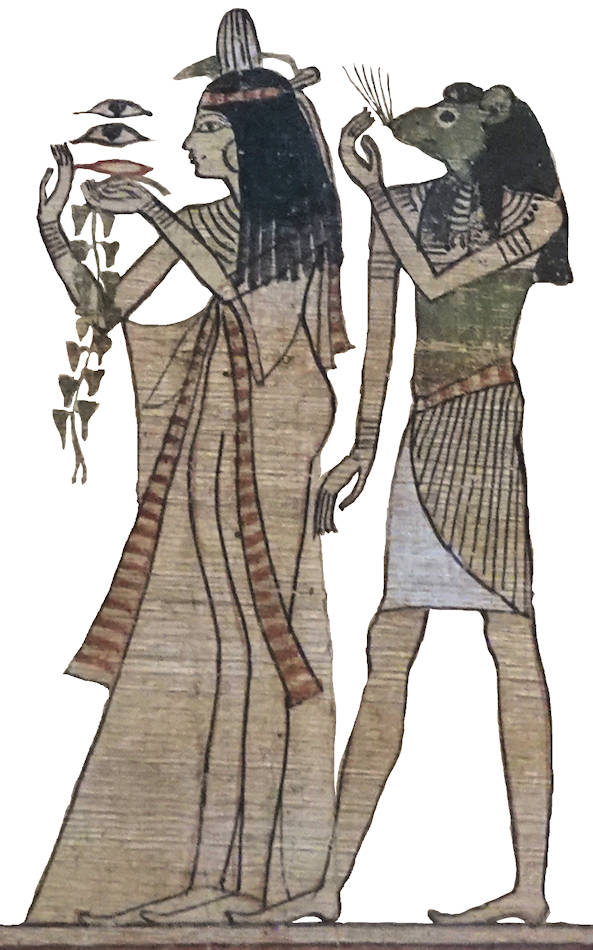
Taudjatra reclaims her mouth and eyes
Spell 1
For going forth by day
Recited on the day of burial, this spell seeks admission to the house of Osiris, continued sustenance, and freedom to enter and leave. Through identification with Thoth and other divine and priestly participants in the protection and vindication of Osiris and Horus, the deceased claims participation in their sacred rites and a corresponding acceptance free from accusations of wrongdoing.
The deceased’s Ba is to join the excellent Ba’s in the house of Osiris, sharing their faculties, receiving daily bread and beer, and moving without obstruction. The deceased enters praised, leaves beloved, and exercises authority within Osiris’s domain
Longer versions add acceptance among the gods, passage aboard the Neshmet-barque, and transformation at will. Concluding instructions promise that knowledge or inscription of the text enables the deceased to go forth by day, return unhindered to the tomb, and receive offerings and agricultural provision in the Field of Reeds. Together, these benefits secure continued life through acceptance, sustenance, mobility and effective action
See Totenbuch
See Faulkner, 1985, p. 34

Detail Vignette Spell 1
Vignettes – 18
Spell 1B
For permitting the noble dead to descend into the Netherworld on the day of interment
This spell secures the deceased’s descent into the Netherworld and protection from its dangers. Knowledge of the beings of the West and their names protects against the snakes of Rosetau, while the deceased requests a place in the darkness and a spirit-form. The concluding instructions link recitation with access to the sacred barque of Re and the enduring existence of the body in the Netherworld
Whereas Spell 1 emphasises admission to the house of Osiris, vindication and sustenance, Spell 1B focuses on protection from Netherworld dangers and securing a place and form of existence there
See Faulkner, 1985, p. 34
Spell 1B is listed in the Totenbuch database as ‘172 (Pleyte)/1B’, reflecting the alternative numbering of this composition. It should not be confused with Spell 172 in Naville’s numbering
Although the Totenbuch mentions four papyri containing a vignette for Spell 1B/172 (Pleyte), I have been unable to locate any images
Spell 2
Going forth by day and living after death
This spell enables the deceased to go forth by day and live and act freely after death. Addressing the ‘Sole One’ who shines as the moon, the deceased seeks release and an opening of the Netherworld, allowing renewed access to the world of the living. Some versions extend this theme to include the granting of spiritual power and life, mastery over an enemy, and recognition by the gods. Despite these variations, the central concern remains the deceased’s freedom of movement and ability to act beyond death
See Totenbuch
See Faulkner, 1985, p. 36

Spell 3
Renewed Life in the Company of the Gods
Whereas Spell 2 emphasizes release from the netherworld and freedom to act on earth among the living, Spell 3 develops the theme through Re’s daily regeneration and the deceased’s admission to the divine company
The spell invokes Atum and affirms the deceased’s renewed life on the model of Re’s daily regeneration. A shared divine origin links the deceased to the sun god, while the closing passage celebrates participation in the living community of the gods
See Totenbuch
See Faulkner, 1985, p. 36

Spell 4
Passing on the upper road of Rosetjau
This spell concerns the deceased’s passage along a route described as the upper road of Rosetjau or, more generally, as a road over land. The deceased claims the identity of one who bounds the flood and separates “the Two,” associating their passage with the establishment of order. The closing statement connects their arrival with Osiris and his fields, although its wording and meaning vary between versions
See Totenbuch
See Faulkner, 1985, p. 36
No vignettes found
Spell 5
Not doing work in the realm of the dead
Chapter 5 and Chapter 6 both address the deceased’s wish to avoid performing labour in the hereafter. Chapter 5 expresses this aim directly, while Chapter 6 instructs a shabti to undertake the work if the deceased is called upon to perform it
The vignette for Sutymes is unique; while the Totenbuch database mentions one other record, that alternative vignette (depicted above Chapter 5) is heavily damaged, leaving only the feet and part of the skirt visible
See Totenbuch
See Faulkner, 1985, p. 36

Spell 6
For causing a shabti to do work for a man in the realm of the dead
The purpose of Chapter 6 is to free the deceased from the manual labour that could be demanded of him in the hereafter. Egyptians imagined the afterlife, and especially the Field of Reeds, as an agricultural landscape governed much like the earthly state, with a system of compulsory labour (corvée). Anyone could be called up to work the fields, maintain the irrigation channels or move soil. The spell guards against this by magically activating a substitute worker, the shabti figurine placed in the tomb, which takes on these duties in place of its owner
The text speaks to the shabti directly, as the figure “allotted” to the deceased. If the deceased is summoned or assigned to any work in the realm of the dead, the shabti must step forward and take his place. The spell names the tasks it is expected to do: making the fields arable, flooding the riverbanks and carrying sand from the east to the west. These are the basic jobs of Egyptian farming and irrigation. The shabti is told to answer every call-up with the short reply “Here I am”. The deceased can then rest undisturbed while his substitute does the work
The rare vignette (only 8 known on TB, 7 here) typically appears in one of three variations: [1] a single mummiform figure, [2] a shabti with agricultural tools such as hoes and a basket, or [3] a deity handing over a shabti to the deceased
See Totenbuch
See Faulkner, 1985, p. 36

Spell 7
For passing by the dangerous coil of Apep
The main purpose of this spell is to protect the deceased from Apep’s poison and power to cause weakness or immobility, enabling passage past his dangerous sandbank. The deceased rejects these threats by asserting a connection with Atum, through identification with the god or emergence from him, and by claiming divine protection
The address to Apep as “the one of wax” suggests a ritual context involving a wax representation of the enemy, although the spell alone does not establish how such a figure was used
See Totenbuch
See Faulkner, 1985, p. 36
Totenbuch lists 7 registered, but I can’t make sense of it
Spell 8
For opening up the West by day
This spell seeks to open the West to the deceased, while affirming that they will not remain there. Its invocations connect this opening with Thoth and the Eye of Horus, described in relation to its position on Re’s head. Through divine identification, a declaration of non-hostility towards Horus, and the prospect of being numbered among the gods, the deceased seeks release and acceptance within the divine community sphere
See Totenbuch
See Faulkner, 1985, p. 36

Spell 9
For going out into the day after opening the tomb
The main purpose of this spell concerns the release of the deceased’s Ba and shadow from the tomb through a legally and ritually authorised opening of the Netherworld
By identifying with Horus as the beloved son of Osiris and by declaring that every path in heaven and on earth has been opened, the deceased claims the recognised authority to see Osiris, dispel darkness, and overcome Seth’s harm. The spell therefore makes posthumous mobility dependent not merely on divine kinship but on the deceased’s active assertion of an Osirian right to emerge into daylight and remain effective after death
See Totenbuch
See Faulkner, 1985, p. 37

Spell 10
For going out into the day against his foes in the realm of the dead
The main purpose of this spell concerns enabling the deceased to emerge into daylight as an empowered and protected being, able to move beyond the confines of the tomb
The deceased claims divine agency by lifting the arm of the falcon god, subduing the forces hostile to the solar order, and establishing authority over the enemies of Osiris. The spell belongs to the early sequence concerned with release and mobility, and it is repeated later in the corpus as Spell 48
See Totenbuch
See Faulkner, 1985, p. 37

Spell 11
For going out against a foe in the realm of the dead
The main purpose of this spell concerns the deceased’s emergence into daylight while retaining the power to resist and defeat hostile forces in the realm of the dead
The deceased identifies with Re and claims the authority to pass beyond enemies who would obstruct posthumous movement. By aligning with the victorious solar god, the spell establishes continued mobility, protection, and effective life after death. Concerned with going out against an enemy in the Netherworld, this spell also occurs in the numbered corpus as Spell 49
See Totenbuch
See Faulkner, 1985, p. 37
Spell 12
For going in and out
The main purpose of this spell concerns the deceased’s authorised return to and re entry into the Duat after going forth into the daylight
Having completed the outward movement characteristic of the preceding spells, the deceased addresses Re as guardian of the gates and asserts access to the western realm. The spell thus secures a reciprocal cycle of departure and return, ensuring that solar mobility does not result in exclusion from the Netherworld or confinement outside the divine order. Concerned with freedom to enter and leave, this spell also occurs in the numbered corpus as Spell 120
See Totenbuch
See Faulkner, 1985, p. 37
Spell 13
For going in and out of the West
The main purpose of this spell concerns the deceased’s secure re entry into the Duat after the daily emergence into the daylight
The deceased presents this return as an authorised transition within the cyclical movement between the solar and netherworld realms, ensuring continued access to the divine West rather than permanent separation from it. Concerned with re-entry after going out, this spell also occurs in the numbered corpus as Spell 121
See Totenbuch
See Faulkner, 1985, p. 37
Spell 14
For removing anger from the heart of the god
The main purpose of this spell concerns removing divine anger towards the deceased, so that they may be received favourably rather than rejected or harmed in the Netherworld
The deceased declares that wrongdoing has been washed away, asks the Lords of Justice to remove the evil within them, and offers a propitiatory offering to the offended god. The spell thus uses ritual speech, purification, and offering to seek the divine favour required for a secure posthumous existence
See Totenbuch
See Faulkner, 1985, p. 39
Spell 15
Worship of Re when he rises in the horizon until the occurance of his setting in life
The main purpose of this spell concerns the deceased’s praise of Re throughout the solar god’s daily course, thereby securing participation in the cyclical renewal of light, life, and divine order
Spell 15 is not one fixed composition but a corpus of solar hymns, varying between manuscripts, which celebrate Re at his rising, transit, and setting. Through ritual adoration, the deceased seeks to be illuminated by Re, to join his following, and to share in the god’s perpetual renewal
See Totenbuch
See Faulkner, 1985, p. 40

Spell 16
Vignette showing the adoration of the rising sun
Spell 16 does not exist as an independent textual composition. The number was assigned by nineteenth century scholars to a full height vignette of solar worship, intended to accompany the hymns to Re collected under Spell 15
Spell 17
Praises and recitations, going in and out of the realm of the dead
The main purpose of this spell is to secure the deceased’s regeneration by identifying them with the creator god and granting them the sacred knowledge required for continued life in the divine realm.
The composition combines cosmogonic declarations with exegetical glosses concerning creation, the solar cycle, the divine body, and the conflict of Horus and Seth. Its efficacy rests on knowledge and identification: by uttering and understanding these statements, the deceased is incorporated into the enduring order of the gods.
See Totenbuch
See Faulkner, 1985, p. 44
Spell 18
Vindicating the deceased through Thoth before the tribunals of the gods
The main purpose of this spell is to obtain the deceased’s vindication against enemies through Thoth’s authoritative intervention before the divine tribunals
The composition repeatedly addresses Thoth, asking him to vindicate Osiris against his enemies and to vindicate the deceased in the same manner. Its litany proceeds through ten sacred places and their divine councils, including Djedu (Busiris), Letopolis (Khem), and Pe and Dep (the twin towns of Buto in Lower Egypt), situating the deceased’s legal and ritual justification throughout Egypt’s sacred geography
See Totenbuch
Not in Faulkner, see T George Allen, 1974, The Book of the Dead or Going Forth by Day
Spell 19
For a garland of vindication
The main purpose of this spell is to confer the garland of vindication upon the deceased, a floral emblem signifying that they have been declared just and triumphant over their enemies
The garland marks the deceased’s successful justification within the posthumous judicial process and associates them with Osiris, whose vindication establishes the model for the justified dead. Spell 19 is conventionally classed with the judicial sequence, although manuscript traditions and modern editions vary in how its brief material is delimited and arranged
See Totenbuch
Not in Faulkner, see T George Allen, 1974, The Book of the Dead or Going Forth by Day
Spell 20
The deceased appeals to Thoth to vindicate him before the tribunals of the gods
The main purpose of this spell is to obtain the deceased’s comprehensive vindication against hostile opponents through Thoth’s legal and authoritative intervention before the divine councils
The composition reinforces the judicial strategy of Spell 18 through repeated appeals to Thoth, who is asked to defend the deceased and defeat their enemies. Its litany establishes the deceased’s right and justification before tribunals in sacred places including Heliopolis, Busiris, and Rosetjau, invoking the precedent of Horus’s victory over his foes to secure enduring validation within the cosmic order
See Totenbuch
See Faulkner, 1985, p. 50
Spell 21
For giving a mouth to N for him in the realm of the dead
The main purpose of this spell is to restore the deceased’s mouth, enabling them to speak effectively and participate in the vital practices of the afterlife
The deceased appeals to the Lord of Light for a mouth with which to speak and for the heart’s proper guidance. Spell 21 begins the group of mouth related compositions that adapt the funerary Opening of the Mouth rite to the continued animation, nourishment, and ritual agency of the dead
See Totenbuch
See Faulkner, 1985, p. 51
Spell 22
For giving a mouth to N for him in the realm of the dead
The main purpose of this spell is to restore the deceased’s power of speech so that they may speak and defend themself before the Great God and the tribunal of the gods
The deceased declares that their mouth has been given back and that their hand will not be repelled in the divine tribunal. By identifying with Osiris, Lord of Rosetjau, the speaker makes the restoration of speech an instrument of juridical access, self representation, and vindication in the afterlife
See Totenbuch
See Faulkner, 1985, p. 51
Spell 23
For opening the mouth of N
The main purpose of this spell is to ritually release and animate the deceased’s mouth, restoring speech, breath, and effective ritual power in the afterlife
The text invokes Ptah, who opens the mouth with the metal implement used to open the mouths of the gods, while Thoth breaks the bonds that Seth has placed upon it through his magical knowledge. The deceased finally assumes the powerful identity of Sekhmet, ensuring that the restored voice possesses both protective and performative authority
See Totenbuch
See Faulkner, 1985, p. 51

Spell 24
For bringing magic to N
The main purpose of this spell is to provide the deceased with the magical power required to counter hostile forces and to act effectively in the realm of the dead
The deceased declares possession of heka, the authoritative power of divine speech and ritual action, so that no hostile spell, command, or magical attack can prevail against them. In sequence with Spell 23, it turns the restored mouth into a protected instrument through which the deceased can deploy effective sacred words
See Totenbuch
See Faulkner, 1985, p. 52
Spell 25
For causing that N be remembered in the realm of the dead
The main purpose of this spell is to ensure that the deceased remains remembered and recognised in the realm of the dead, thereby preserving their continuing identity and social existence
The spell protects the deceased from oblivion, which would threaten their effective survival after death. To be remembered is to remain known among gods and blessed dead, able to retain one’s name, status, and place within the ordered community of the afterlife
See Totenbuch
See Faulkner, 1985, p. 52
Spell 26
For giving N’s heart to him in the realm of the dead
The main purpose of this spell is to restore the deceased’s heart, ensuring the return of the organ understood as the seat of consciousness, memory, intention, and moral identity
The spell prevents the heart from being separated from its owner in the realm of the dead, where such loss would endanger the deceased’s personal integrity and capacity for judgement. Its concern with recovery and possession of the heart anticipates the more explicitly judicial heart spells that protect the deceased during the assessment before the gods
See Totenbuch
See Faulkner, 1985, p. 52
Spell 27
For not letting a man’s heart to be taken from him in the realm of the dead
The main purpose of this spell is to prevent the seizure and oblivion of the deceased’s heart by directly confronting the heart stealers and the Lords of Years
The deceased addresses those who take and steal hearts and cause the heart’s oblivion, but asserts a position of primordial mastery over them. This claim of cosmic authority transforms the spell from a passive request for protection into an act of command, securing the heart as the indispensable locus of identity, consciousness, and effective posthumous existence
See Totenbuch
See Faulkner, 1985, p. 53
Spell 28
For not permitting N’s heart to be taken from him in the realm of the dead
The main purpose of this spell is to prevent the heart choppers from taking or mutilating the deceased’s heart, thereby safeguarding the centre of personal identity, consciousness, and posthumous agency
The deceased commands the heart choppers not to remove the heart and grounds this protection in solar and Heliopolitan identifications. By invoking the great lion god and Atum, the speaker establishes that the heart belongs within the highest divine order and cannot be seized by the hostile executioners
See Totenbuch
See Faulkner, 1985, p. 53
Spell 29
For not permitting N’s heart to be taken away from him in the realm of the dead
The main purpose of this spell is to repel the messenger of a god who has come to seize the deceased’s heart, preserving the organ as the basis of the deceased’s identity and continued life
The deceased orders the messenger to return and refuses to surrender the living heart. The claim is reinforced through the recognition of the deceased’s offerings by the gods, who are represented as submitting before the speaker, thereby denying the messenger any effective claim over the heart
See Totenbuch
See Faulkner, 1985, p. 54
Spell 29A
For not taking away the heart of one whose conduct has been vindicated in the realm of the dead
The main purpose of this spell is to prevent the heart of the vindicated deceased from being taken away, safeguarding the organ on which their identity, consciousness, and effective afterlife depend
The formulation makes the deceased’s vindicated conduct central to the heart’s protection. The spell therefore grounds bodily integrity not merely in resistance to seizure, but in the deceased’s recognised moral and juridical standing in the realm of the dead
See Totenbuch
See Faulkner, 1985, p. 54
Spell 29B
For a heart amulet of sehret-stone
The main purpose of this spell is to protect the deceased’s heart by consecrating a heart amulet placed with the mummy, thereby safeguarding the organ essential to identity, consciousness, and effective existence after death
The rubric specifies an amulet of green jasper or red stone material, rather than treating seheret as the required substance of the heart itself. The formula therefore unites recitation with a physical funerary object that serves as a protective counterpart to the deceased’s heart
See Totenbuch
See Faulkner, 1985, p. 55
Spell 30
For not letting N’s heart create opposition against him in the realm of the dead
This spell addresses N’s heart, calling upon it not to rise as a witness against him or oppose him before the divine tribunal. The appeal seeks to preserve the heart’s allegiance during judgment, while the assembled gods are asked to speak favourably of N and entrust him to Nehebkau
The formula seeks enduring existence on earth and eternal transfiguration in the West, where N is not to die again. Its ritual instructions prescribe recitation over a stone scarab covered with gold and placed within the deceased’s heart region, linking the spoken protection to an amuletic safeguard
The designations 30A and 30B distinguish two related textual versions of the heart spell, rather than successive sections. Both seek to prevent N’s heart from testifying against him, but differ in wording and development; 30B is the more widely attested version and is frequently inscribed on heart scarabs
See Totenbuch
Not in Faulkner
Spell 30A
For not letting N’s heart create opposition against him in the realm of the dead
The main purpose of this spell is to prevent the deceased’s heart from testifying or acting against its owner during the judgement in the realm of the dead
The deceased addresses the heart as an intimate and indispensable part of the self, commanding it not to betray them before the divine tribunal. By securing the heart’s loyalty, the spell protects the deceased from adverse testimony that could obstruct vindication and continued life after death
See Totenbuch
See Faulkner, 1985, p. 55
Spell 30B
The judgement of the dead
The main purpose of this spell is to prevent the deceased’s heart from bearing adverse witness or creating opposition during the judgement before the Great God
The deceased addresses the heart as the heart inherited from the mother and as an essential component of the self, commanding it not to speak against them before the tribunal. The rubric associates the formula with a heart scarab placed upon the body, joining the spoken appeal to an amuletic safeguard against condemnation in the afterlife
See Totenbuch
See Faulkner, 1985, p. 27, 56

Spell 31
For driving off a crocodile which comes to take away N’s magic from him in the realm of the dead
The main purpose of this spell is to repel the crocodile that seeks to deprive the deceased of magical power, safeguarding the ritual knowledge and speech required for effective existence in the realm of the dead
The deceased confronts the crocodile through divine identifications and commands, denying it access to the sacred power of heka. The spell thus protects the magical efficacy on which the deceased depends to overcome threats, address the gods, and sustain an active posthumous life
See Totenbuch
See Faulkner, 1985, p. 56
Spell 32
For repelling a crocodile which comes to take away N’s magic from him in the realm of the dead
The main purpose of this spell is to repel the crocodiles that attack the deceased from the four cardinal directions, protecting the magical power on which posthumous survival depends
The text confronts crocodiles of the south, north, west, and east through a network of divine identifications and protective powers. Soped protects against the southern threat, Serket figures in the northern formula, Seth repels the western crocodile, and Osiris confronts the eastern one; in some textual forms this directional system expands to eight crocodiles
See Totenbuch
See Faulkner, 1985, p. 56
Spell 33
For driving of a snake
The main purpose of this spell is to drive away the Rerek serpent by ritually discrediting it and invoking primordial divine protection for the deceased
The speaker commands the Rerek serpent to withdraw, invoking Geb and, in some versions, Shu as protectors. The serpent is deprived of legitimacy through the accusation that it has consumed a mouse hated by Re and gnawed the bones of a putrid cat, abominable acts that align it with cosmic disorder and, by association, the hostile serpent Apep
See Totenbuch
See Faulkner, 1985, p. 58
Spell 34
For not being bitten by a snake in the realm of the dead
The main purpose of this spell is to prevent the deceased from suffering a snakebite, using divine identification to render the serpent unable to approach or harm them
The speaker addresses the cobra directly and identifies themself as the flame that shines upon the brows of the primeval gods, then as Mafdet, a divine protector associated with the destruction of serpents. These identifications turn the deceased into an actively dangerous force for the snake, rather than merely a passive recipient of protection
See Totenbuch
See Faulkner, 1985, p. 58
Spell 35
For not being eaten by a snake in the realm of the dead
The main purpose of this spell is to prevent the deceased from being devoured by a snake, thereby averting the complete destruction of the body and continued posthumous existence
The text repels the threatening serpent through direct commands and by the deceased’s identification with Osiris. Within the anti serpent sequence, the formula addresses the distinctive danger of total consumption rather than snakebite or a more general serpentine assault
See Totenbuch
See Faulkner, 1985, p. 58
Spell 36
For repelling a beetle
The main purpose of this spell is to drive away the apshai insect, a crawling threat understood to endanger the deceased’s preserved body
The deceased dismisses the being as Crooked Lips and identifies with Khnum, Lord of the Circuit, the divine messenger who carries and reports the words of the gods to Re. This assertion of divine authority protects the mummy from the insect’s destructive approach; the rubric further promises that the deceased who knows the spell will not decay in the underworld
See Totenbuch
See Faulkner, 1985, p. 58

Spell 37
For repelling the two songstress-snakes
The main purpose of this spell is to repel the two meret snakes by asserting the deceased’s royal and solar identity, which makes an attack upon them an offence against Horus’s own authority
The deceased commands the pair to withdraw and identifies themself as the shining Lord of Strength who has received the crown and sits upon the throne of Horus. The formula therefore establishes protection through status and cosmic affiliation rather than through a general request for safety
See Totenbuch
See Faulkner, 1985, p. 58

Spell 38
For living by air in the realm of the dead
This spell secures the breath required for N’s continued existence in the Netherworld. Its title also associates the formula with warding off the two Meret goddesses, bringing protection against hostile powers together with the preservation of life through air.
Breathing sustains N’s capacity to act and participate in the divine realm. In the version designated 38B, N identifies himself with Ruty, seeks an unobstructed path, and stands aboard the bark of Re. Opening his mouth and partaking of life culminate in the affirmation that he lives again after death, like Re each day.
The designations 38A and 38B distinguish two related recensions, rather than successive sections. Both concern living by air, but differ in wording and development; 38B explicitly connects renewed life with passage aboard the solar bark and Re’s daily renewal. The unlettered designation “38” should not automatically be treated as a third independent composition
See Totenbuch
Not in Faulkner
Spell 38A
For living by air in the realm of the dead
The main purpose of this spell is to obtain the breath of life in the realm of the dead through the deceased’s integration into restored cosmic and divine order
The deceased identifies with Atum and declares association with Horus and Seth, the Two Lords, presenting their reconciliation as the condition for renewed vitality. Its vignette commonly shows the deceased holding a mast with an unfurled sail, an image that materializes the life giving wind or breath sought through the formula
See Totenbuch
See Faulkner, 1985, p. 58

Spell 38B
Another spell for living by air in the realm of the dead
The main purpose of Spell 38B is to secure continuing life through air in the underworld, but it does so through a strongly solar and royal self-identification rather than through the reconciliation of Horus and Seth characteristic of 38A
The deceased declares themself to be the Double Lion, first-born of Re, and Atum of the Two Lands. By claiming this solar identity and service before Re at the horizon, the deceased asserts the right to live anew each day, to be empowered by the Double Lion, and to emerge like the lotus bloom
The formula thus joins breathing with solar rebirth: air is not merely survival, but the divine vitality that permits the deceased to accompany Re and renew their existence. Spell 38B also appears independently in diverse manuscript sequences, supporting treatment as its own entry rather than an appendix to 38A
See Totenbuch
See Faulkner, 1985, p. 58
Spell 39
For repelling a Rerek-snake in the realm of the dead
This spell protects the deceased from Rerek, a chaotic serpent closely aligned with Apophis, by placing the deceased among the divine defenders of Re
It stages not a general act of protection but the violent defeat of the snake: its speech is overthrown, its face turned upside down, its heart cut out by Mafdet, and its body bound by the scorpion goddess Serket
See Totenbuch
See Faulkner, 1985, p. 60
Spell 40
For repelling him who swallowed the ass
This spell protects the deceased from a hostile serpent identified by its devouring of an ass, an act that marks it as a disruptive and dangerous force in the realm of the dead
The deceased drives the serpent away through direct command and solar identification, declaring protection under Re and invoking the enemy’s destruction in the primeval waters
Its purpose is to prevent the snake from endangering or overpowering the deceased, securing safe movement and continued integrity within the divine order
See Totenbuch
See Faulkner, 1985, p. 61
Spell 41
For preventing the slaughter which is carried out in the realm of the dead
This spell protects the deceased from the slaughter carried out by the hostile executioners or demonic servants of Osiris in the realm of the dead
The deceased asserts divine authority and right of place among the gods, refusing to be seized, killed, or assigned to the punishment reserved for Osiris’s enemies
Its central concern is bodily survival: the deceased must remain whole and alive in the afterlife rather than become a victim of divine retribution or underworld violence
See Totenbuch
See Faulkner, 1985, p. 61
Spell 41B
For seizing the Merety-serpents
This spell protects N from the Merety, a pair of serpentine beings whose destructive power must be restrained. By identifying himself with Horus, son of Osiris, N asserts a divine identity through which he can confront these beings and prevent their power from being directed against him.
The formula establishes protection through divine recognition and authority rather than physical escape alone. The serpents’ potentially hostile force is brought under control, safeguarding N’s continued existence in the Netherworld
See Totenbuch
Not in Faulkner
Spell 42
For preventing the slaughter which is carried out in Heracleopolis
This spell protects the deceased from underworld slaughter by declaring that every bodily part belongs to, or is identified with, a specific deity
This systematic divine mapping moves from the head towards the feet: for example, the eyes are Hathor’s, the lips Anubis’s, the neck Isis’s, the back Seth’s, the phallus Osiris’s, the stomach and spine Sekhmet’s, and the feet Ptah’s
Because no part of the body is without a god, the deceased’s body becomes divinely guarded and cannot legitimately be mutilated, seized, or destroyed
See Totenbuch
See Faulkner, 1985, p. 62
Spell 43
For preventing a man’s decapitation in the realm of the dead
This spell protects the deceased from losing their head in the underworld, a fate associated with irreversible destruction rather than a temporary bodily injury
The deceased identifies as “a Great One” and “a flame, the son of a flame,” whose head was restored after it had been cut off. Through identification with Osiris, whose head must not be taken, the deceased asserts that their own head likewise cannot be removed
The formula consequently seeks restoration and continued personal integrity: the deceased is to be raised up, renewed, and preserved as a complete being
See Totenbuch
See Faulkner, 1985, p. 63
Spell 44
For not dying again in the realm of the dead
This spell prevents the deceased from undergoing a second death in the underworld, securing continued and incorruptible existence after physical death
The deceased claims divine and solar status: the Eye of Horus supports them, Wepwawet raises and conceals them among the Imperishable Stars, and their throat, face, heart, and speech are aligned with Re and divine knowledge
The spell culminates in the declaration that the deceased has risen as king of the gods and will not die again
See Totenbuch
See Faulkner, 1985, p. 63
Spell 45
For not putrefying in the realm of the dead
Here the deceased protects their body from exhaustion, decay, and putrefaction by identifying its members with those of Osiris
The formula insists that the limbs of Osiris shall neither grow weary nor decay, and extends that same permanence to the deceased’s body
Rather than merely preserving a mummy, the spell secures the deceased’s capacity to remain physically intact and effective in the realm of the dead
See Totenbuch
See Faulkner, 1985, p. 64
Spell 46
For not perishing and for being alive in the realm of the dead
This spell protects the deceased from perishing through deprivation, confinement, and the loss of vital agency in the realm of the dead
The deceased identifies with the Lord of the Horizon and asserts that their Ba cannot be destroyed or held captive in the darkness of the corpse or tomb
Its aim is to sustain a living, mobile posthumous existence: the deceased retains breath and the ability to move between the tomb, the earth, and the celestial realm
The desired result is exclusion from execution and continued life in the realm of the dead, rather than admission to the place of divine butchery
See Totenbuch
See Faulkner, 1985, p. 64
Spell 47
For preventing the taking of N’s place and throne from him in the realm of the dead
This spell secures the deceased’s rightful place and throne in the divine realm, preventing another being from usurping their status or position
The deceased directly summons their own place and throne to serve them, affirming that both properly belong to them. The formula therefore treats status in the afterlife as something that must be claimed, recognised, and guarded against displacement
Its aim is lasting membership in the divine order: the deceased retains not merely physical survival but the authority, seat, and dignity due to an effective spirit in the realm of the dead
See Totenbuch
See Faulkner, 1985, p. 64
Spell 48
For going out into the day against his foes in the realm of the dead
This spell is a duplicate of Spell 10, representing the same composition under a different spell number
For vignettes, see Spell 10
Spell 49
Spell for walking and conquering one’s enemies
This spell empowers the deceased to confront and overcome hostile beings in the underworld, allowing them to go forth without being obstructed or harmed
The speaker commands the enemy to fall and tremble at the eastern horizon, and portrays the threat as reduced or transformed into a flea, thereby stripping it of power
Although related to Spell 11 in the modern numbering, Spell 49 merits its own entry because it frames successful emergence as an active victory over opposition rather than simply the right to depart
Not in Totenbuch
Not in Faulkner, see T George Allen, 1974, The Book of the Dead or Going Forth by Day
Spell 50
For not entering into the shambles of the god
This spell protects the deceased from the god’s shambles, a place of execution where destructive punishment is concentrated in the realm of the dead
Its distinctive logic is paradoxical: the deceased does not overcome the slaughterhouse by violence, but rejects it as a destination while claiming a protected position in the solar and divine order
The shambles is imagined through the concrete apparatus of execution, notably a great knife descending between two uprights, so that escape from it means preserving the body, identity, and future life of the deceased
The Totenbuchprojekt distinguishes 50, 50A, and 50B as separate catalogue entries. Tb 50 concerns avoiding the god’s slaughter-place. The separate registration of 50A and 50B means that it should not automatically be treated as an alternative label for 50; the precise textual relationship requires further comparison
See Totenbuch
See Faulkner, 1985, p. 65
Spell 51
For not walking upside down in the God’s Domain
This spell prevents the deceased from moving upside down in the realm of the dead, a condition that signifies loss of orientation, status, and effective agency
The formula secures an upright and stable position by aligning the deceased with the ordered movement of the gods and the sun
Its purpose is to preserve bodily control and proper direction, ensuring that the deceased can travel through the afterlife as a complete and capable spirit
See Totenbuch
Not in Faulkner, see T George Allen, 1974, The Book of the Dead or Going Forth by Day
Spell 52
For not eating faeces in the realm of the dead
This spell protects the deceased from the degrading necessity of eating faeces in the realm of the dead, an outcome incompatible with their purified and divinely sustained existence
The deceased rejects this impure substance as abhorrent and claims instead the proper nourishment of the blessed dead. The formula therefore expresses the preservation of ritual purity, dignity, and continued life rather than merely an aversion to foul food
See Totenbuch
Not in Faulkner, see T George Allen, 1974, The Book of the Dead or Going Forth by Day
Spell 53
For not eating dung and not drinking urine in the realm of the dead
The main purpose is to secure pure, life sustaining nourishment for the deceased, extending the narrower refusal of faeces in Spell 52 to include the rejection of urine
Rather than merely refusing polluted food, the deceased claims the proper provisions of the gods, identifying with the celestial order and receiving bread through the day and night barques of Re
The formula also rejects walking upside down, linking divine nourishment with upright bodily integrity, freedom of movement, and continued life in the ordered cosmos
See Totenbuch
See Faulkner, 1985, p. 65
Spell 54
For giving breath to N in the realm of the dead
The main purpose is to restore the life giving breath that allows the deceased to remain active and alive in the realm of the dead
The deceased appeals to Atum for the sweet breath from his nostrils and identifies with the cosmic egg of the Great Cackler, whose continued life and breathing guarantee the deceased’s own renewal
Breath is presented as a divine substance rather than a merely physical necessity, connecting survival after death to the cycle of cosmic creation and solar regeneration
See Totenbuch
See Faulkner, 1985, p. 65
Spell 55
For giving breath in the realm of the dead
This formula offers another means of restoring breath, presenting the deceased as a heavenborn being who stands in the presence of the Great Gods
Its opening evokes distress in both sky and Duat before identifying the deceased with the cosmic renewal that overcomes this disorder
Breath is consequently framed as a sign of restored divine vitality, allowing the deceased to remain present, animate, and effective among the gods
See Totenbuch
See Faulkner, 1985, p. 66
Spell 56
For breathing air amongs the waters of the realm of the dead
The main purpose is to secure breathable air and safe passage amid the waters of the realm of the dead
The deceased addresses the Great Wild Bull of Heliopolis, commanding this solar guardian to make way, provide protection, and keep them safe from the water
Breath is thus obtained through guarded access to a protected sacred space, rather than through a direct appeal to Atum’s nostrils
See Totenbuch
See Faulkner, 1985, p. 66
Spell 57
For breathing air and having power over water in the realm of the dead
The main purpose is to give the deceased command over both breath and water, ensuring that the two essential elements of posthumous life remain available rather than threatening
The speaker invokes Hapi, the Great One of the sky, and asks to hold power over water as Osiris does. Open nostrils in Busiris and rest in Heliopolis connect breathing to legitimate access to two major sacred centres
See Totenbuch
See Faulkner, 1985, p. 67
Spell 58
For breathing air and having power over water in the realm of the dead
At its core, the formula secures the deceased’s breath and authority over water through a ritual encounter with the ferryman. The deceased establishes the right to proceed by answering questions of identity and demonstrating knowledge of divine names and associations
Unlike Spell 57, which invokes Hapi and claims direct command over the life giving elements, Spell 58 makes access conditional on successful passage and recognition. Spell 57 is an elemental claim to breath and water, whereas Spell 58 is a navigational formula that turns mastery of those elements into authorised movement across the underworld waters
See Totenbuch
See Faulkner, 1985, p. 68
Spell 59
For breathing air and having power over water in the realm of the dead
The formula obtains breath and access to water through the celestial sycamore, a sacred tree associated with the sky goddess Nut
The deceased identifies their own vitality with the guarded egg of the Great Cackler: if the egg grows, lives, and breathes, so too does the deceased. Unlike Spells 57 and 58, which establish elemental authority through Hapi or passage by the ferryman, this formula grounds survival in reciprocal renewal with a cosmic tree and egg
See Totenbuch
See Faulkner, 1985, p. 68
Spell 60
For drinking water in the realm of the dead
This formula reinforces the deceased’s command over breath and water through identification with the primeval creator who brought the primordial waters into being
By claiming to be the soul who created the Nun and established a seat in the realm of the dead, the deceased speaks from a position prior to, and therefore superior to, the waters that might otherwise obstruct survival
Unlike Spell 59, which receives air through the celestial sycamore and the Great Cackler’s egg, Spell 60 makes elemental security depend on creative mastery of the primeval waters
See Totenbuch
Not in Faulkner, see T George Allen, 1974, The Book of the Dead or Going Forth by Day
Spell 61
For not letting a man’s soul be taken away from him in the realm of the dead
Within Faulkner’s sequence, Spell 61 completes the preceding concern with securing the necessities of posthumous life by protecting the deceased’s Ba at the moment when access to water remains essential. Rather than merely restating a general wish for personal integrity, it safeguards the mobile spiritual component through which the deceased can receive and enjoy the life-giving water claimed in the surrounding compositions
The spell therefore treats the retention of the Ba as a condition of effective sustenance in the netherworld. Its placement before Spell 62, explicitly entitled Spell for drinking water in the realm of the dead, creates a deliberate thematic progression: entitlement to water is followed by protection of the person who must draw upon it
See Totenbuch
See Faulkner, 1985, p. 68
Spell 62
For drinking water in the realm of the dead
Having secured both the availability of water and the safety of the Ba, the deceased now claims the practical ability to drink. The great waters, the cool water of Thoth, and the water of Hapi are opened for him, while the divine names Pedsu, the Lord of the Horizon, and Osiris place this access within an explicitly cosmic and Osirian order
The formula goes beyond a request for sustenance by claiming command over the waters “like the limbs of Seth”. Through identification with the sky-crosser, the Lion of Re and the inheritor of eternity, the deceased turns drinking from a dependent act into an assertion of enduring divine power, culminating in access to the pools of the Field of Rushes and to limitless eternity
See Totenbuch
See Faulkner, 1985, p. 68
Spell 63A
For drinking water and not being burnt by fire
This composition develops the preceding water sequence by treating water not only as sustenance, but also as a means of protection against a destructive fiery threat. The deceased identifies himself with the oar of Re by which the Primeval Ones row, thereby adopting an instrument of divine movement and control rather than remaining exposed to the hostile conditions of the netherworld
Addressing the Bull of the West, the speaker claims the capacity to receive water without being consumed by fire. Water and fire are therefore presented as interrelated but potentially dangerous forces, over which the deceased gains security through identification with the solar bark and the primordial divine order
See Totenbuch
See Faulkner, 1985, p. 68

Spell 63B
For not being scalded with water
The second of the two related protective formulas addresses a distinct danger within the water sequence: water itself may become a destructive, scalding force in the netherworld. The deceased therefore seeks immunity not from thirst or fire alone, but from harmful water, preserving the ability to approach and use the divine waters safely
Together with Spell 63A, the composition qualifies the life-giving character of water claimed in Spells 57–62. Access to water must be accompanied by mastery over its dangerous manifestations, so that the waters of the netherworld sustain rather than threaten the deceased
See Totenbuch
See Faulkner, 1985, p. 69
Spell 64
Great formula for going forth by day in a single spell
This spell functions as a comprehensive declaration of the deceased’s renewed divine identity and capacity to emerge into daylight. Its statements bring together central claims found throughout the preceding compositions, including knowledge of divine names, access to air and water, bodily renewal, and participation in the solar and Osirian realms
Positioned at the threshold of the sequence concerned with solar travel, the spell shifts the emphasis from protection against individual dangers to the deceased’s successful and continuing activity among the gods. The spell’s designation as a formula for coming forth by day expresses this transition from securing survival in the netherworld to manifesting freely in the ordered cosmos
See Totenbuch
Not in Faulkner, see T George Allen, 1974, The Book of the Dead or Going Forth by Day
Spell 65
For going out in the day and having power over one’s enemies
This spell makes the deceased’s emergence into daylight contingent upon victory over hostile forces. It frames this demand within a cosmic juridical setting, invoking vindication before the Great God and the Great Ennead rather than presenting the enemy simply as a physical adversary
Its rhetoric is deliberately forceful: refusal to grant the deceased this triumph threatens a reversal of the proper cosmic order, in which Hapi would cease to rise to the sky and Re would descend to the waters. The deceased’s personal vindication is thus represented as inseparable from the continuing stability of the divine world
See Totenbuch
See Faulkner, 1985, p. 69
Spell 66
Another spell for going out into the day
This spell presents the deceased’s emergence into daylight as a process of divine birth and self-identification. By claiming to have been conceived by Sekhmet and born by Satis, and by identifying with Horus emerging from the Eye of Horus and with Wadjet, the speaker obtains a protected and empowered place within the solar order
Unlike Spell 65, which makes coming forth dependent on overcoming enemies through cosmic vindication, Spell 66 does not foreground conflict. Its concern is regenerative identity: the deceased’s authority to appear in daylight derives from affiliation with divine powers of birth, protection, and solar renewal rather than from victory over opponents
See Totenbuch
See Faulkner, 1985, p. 69
Spell 67
For opening the tomb
This formula secures the opening of the tomb and the release of the deceased from its enclosed, subterranean space. By declaring that the cavern is opened for those in darkness and that their bonds are cut, it treats resurrection as both liberation from confinement and restoration to movement
Following the two spells for going out into the day, Spell 67 provides the necessary spatial condition for that movement. Its imagery of opened caverns, severed bonds, and released darkness translates the broader promise of daylight into the concrete passage from tomb to the world beyond
See Totenbuch
See Faulkner, 1985, p. 69
Spell 68
Another spell for going out into the day
The formula equips the deceased with effective power in every faculty and bodily member: heart, arms, legs, mouth, and the totality of the body. This comprehensive empowerment also extends to offerings, air, water, streams, cultivated land, and to human opponents in both the netherworld and the earthly sphere
Where Spell 67 opens the tomb and removes the bonds that prevent departure, Spell 68 defines what the released deceased must possess in order to act successfully outside it. Going forth by day is therefore not merely exit from confinement, but the acquisition of fully operative agency across the divine, natural, and social domains
See Totenbuch
See Faulkner, 1985, p. 69
Spell 69
For being the successor of Osiris
The deceased assumes the role of Osiris’s heir, grounding his continued existence in legitimate succession rather than in mere escape from danger. Through identifications with Orion, Horus, and other divine powers, he claims a place in the celestial and Osirian orders as one authorised to inherit, act, and receive offerings
Where Spell 68 grants the general capacities required for effective movement and agency, Spell 69 gives that agency a specifically dynastic basis. The spell presents the deceased not simply as empowered, but as the rightful successor of Osiris, whose authority is recognised within the divine hierarchy
See Totenbuch
See Faulkner, 1985, p. 70
Spell 70
Another spell for purification and preparation
This alternate formulation of Spell 69 likewise establishes the deceased as an heir within the Osirian order, but it does so through release and restoration rather than through the more extensive claims to celestial and ritual authority made in the preceding spell. The text calls for the deceased to be released and unbound, thereby making inherited status effective as renewed freedom of action
Where Spell 69 presents the deceased positively as Osiris’s successor through a series of divine identities, Spell 70 is a supplementary, concise alternative that foregrounds deliverance from restraint. It retains the same broad Osirian aim but approaches it through loosening bonds and recovering bodily and spiritual wholeness
See Totenbuch
See Faulkner, 1985, p. 71
Spell 71
Another spell for going out into the day
Addressing the falcon who rises from the Abyss and rules the celestial waters, the deceased seeks restoration through the imagery of primordial emergence. The text associates coming forth with release from restraint, protection against seizure in the underworld, and free passage for the Ba out of the sacred land
In contrast to the preceding spells, which establish power through succession, release, or the opening of the tomb, Spell 71 makes solar and primordial renewal central to the deceased’s movement. Its appeal to the falcon links the desired emergence to a divine model of rising from the primeval waters into the ordered celestial realm
See Totenbuch
See Faulkner, 1985, p. 71
Spell 72
For going out into the day and opening up the tomb
This formula combines liberation from the tomb with the deceased’s recognition as an effective Akh. Addressing the justified possessors of souls, the speaker demands entry and declares that he has assumed an Akh-form through his own magic, is acknowledged as such, and knows the names required to negotiate the divine realm
Where Spell 67 focuses on opening the tomb and Spell 71 on rising into the day through primordial and solar associations, Spell 72 unites both objectives in a more elaborate programme of authorised passage. Emergence depends on divine recognition, magical efficacy, speech, sustenance, and knowledge, making the departure from the tomb an entry into the properly ordered realm of the blessed dead
See Totenbuch
See Faulkner, 1985, p. 72
Spell 73
For entering the underworld and coming forth from it
As a repetition of Spell 9, this formula provides the deceased with reciprocal access to the underworld and the world of daylight. Its concern is not simply departure from the tomb, but the ability to move safely across the boundary of the West, entering the netherworld when required and emerging again without obstruction
See Totenbuch
Not in Faulkner, see T George Allen, 1974, The Book of the Dead or Going Forth by Day
Spell 74
For being swift-footed when going out from the earth
This formula seeks to make the deceased swift and unimpeded as he rises from the earth. In addressing Sokar in his cavern, the speaker presents emergence as movement away from the god’s subterranean domain towards radiance above the sky, while his justification in the House of Atum confirms the legitimacy of that transition
The emphasis on swiftness distinguishes this composition from the preceding spells for opening the tomb or securing passage through it. Once release and authorisation have been obtained, the deceased must be able to travel without delay or exhaustion, making physical mobility a necessary expression of renewed life
See Totenbuch
See Faulkner, 1985, p. 73

Spell 75
For going to Heliopolis and receiving a throne there
The deceased seeks admission to Heliopolis and the receipt of a throne in the city where solar and royal authority are concentrated. By identifying himself as the Ba of Re and associating his arrival with the sacred bird that guards the White Crown, he presents his claim as participation in the divine sovereignty of the solar god
The spell marks a development beyond the preceding formulas for release from the tomb and movement into daylight. Its aim is not simply to travel freely, but to obtain a recognised and permanent status in the solar centre, expressed through enthronement and association with the royal insignia
See Totenbuch
See Faulkner, 1985, p. 73
Spell 76
Taking any Form one wishes
This is the general introductory formula to the sequence of transformation spells (BD 76–88). Its rubric, “Spell for becoming in any form one wishes to become,” expresses the deceased’s capacity to assume a desired xprw (“form,” “mode of manifestation,” or “transformation”). The spell introduces a series in which the deceased may take specific divine, animal, vegetal, and avian forms, including the falcon, lotus, bA-bird, swallow, serpent, and crocodile. These transformations are associated with the deceased’s effective agency and mobility in the post-mortem world and, more broadly, with participation in solar renewal. Spell 76 therefore establishes the general premise for the transformations developed in the following spells
The Totenbuch database records vignettes for Spell 76, but I have found no convincing evidence for them
See Totenbuch
Faulkner, 1985, p. 73
“Spell for being transformed into any shape one may wish to take”
Spell 77
Transformation into a Golden Falcon
This spell enables the deceased to assume a radiant divine form. Its emphasis lies on the falcon’s material and celestial splendour: gold evokes the imperishable flesh of the gods, while the bird is endowed with wings of green feldspar and a back measuring seven cubits (approximately 3.7 meters). The spell thus establishes the deceased’s transformed body as both magnificent and enduring
In contrast, Spell 78, also concerned with falcon transformation, focuses less on this detailed, precious physical description and more on the Ba’s divine mobility, authority, and effective emergence. Together, the two spells express complementary aspects of the falcon form: Spell 77 its luminous, divinised body, and Spell 78 its active power and freedom of movement.
See Totenbuch
See Faulkner, 1985, p. 73
“Spell for being transformed into a falcon of gold”

Spell 78
Transformation into a Divine Falcon for Celestial Mobility
This spell enables the deceased to assume the form of a divine falcon and thereby to participate in the celestial course of the sun god. The falcon form confers not merely aerial mobility, but a divinely sanctioned capacity to traverse the heavens, join the solar realm, and exercise enduring posthumous agency
See Totenbuch
See Faulkner, 1985, p. 74
“Spell for being transformed into a divine falcon”

Spell 79
Transformation to an Elder of the Tribunal
This spell enables the deceased to assume the form of an elder of the divine tribunal (DADA.t). Its purpose is not merely to grant elevated status, since other transformation spells likewise associate the deceased with divine forms. Rather, this transformation gives access to the authority, dignity, and recognised standing of those who sit within the divine assembly
In this form, the deceased is no longer presented merely as a petitioner awaiting judgement, but as one who belongs among the venerable beings of the netherworld. The elder embodies maturity, ritual knowledge, and legitimacy within the ordered divine world. The transformation may therefore be understood as securing acceptance and effective status in the presence of the gods
See Totenbuch
See Faulkner, 1985, p. 78
“Spell for becoming an elder of the tribunal”

Spell 80
Transformation into the God Who Gives Light to the Darkness
This spell enables the deceased to assume the form of the god who gives light to the darkness (sHD qqw). Its purpose is not simply to bestow a divine appearance, but to equip the deceased with the power to illuminate the darkness of the Duat and to move knowingly through its hidden regions.
In this form, the deceased becomes a source of light in places otherwise marked by obscurity, danger, and uncertainty. The transformation provides vision, orientation, and protection: it enables the deceased to recognize paths, divine beings, and potential threats within the netherworld.
The spell therefore expresses mastery over darkness rather than mere escape from it. By becoming the one who illuminates the Duat, the deceased secures continued access to light, knowledge, and effective movement, and avoids permanent confinement within the darkness of the tomb or underworld.
See Totenbuch
See Faulkner, 1985, p. 78
“Spell for making transformation into a god and giving light and darkness”

Spell 81A & 81B
Transformation into a Lotus
These closely related spells enable the deceased to assume the form of a lotus (sSn). Their purpose is not simply to confer a beautiful floral form, but to associate the deceased with emergence, regeneration, and the daily renewal of the sun. Rising from the primeval waters, the lotus provides a potent image of rebirth and of renewed life at the moment of dawn
Through this transformation, the deceased participates in the solar cycle and appears in a state of purity and vitality. The lotus is particularly associated with Nefertem, the youthful solar god who emerges from the lotus and embodies renewal, fragrance, and the creative force of the sun. In some vignettes, the head of the deceased rises from the open flower, making the connection between personal rebirth and solar emergence especially explicit
The transformation therefore ensures more than escape from the burial place. It grants the deceased continual rejuvenation, access to the realm of light, and the capacity to be reborn anew with the sun. By becoming the lotus, the deceased overcomes the passivity and decay of death and is no longer confined to the darkness of the tomb or the Duat
See Totenbuch
See Faulkner, 1985, p. 79
“Spell for being transformed into a lotus”

Spell 82
Transformation into Ptah
This allows the deceased to assume the form of Ptah, the creator god and divine craftsman. Rather than providing an avian means of movement, it confers divine vitality, permanence, and effective existence through identification with the god.
In this form, the deceased can receive divine sustenance, specifically bread and beer in the sacred halls of Heliopolis, while rejecting impurity and bodily waste. Although the deceased is described as flying like a falcon and calling as a goose, these images affirm renewed animation rather than define the transformation itself.
The transformation into Ptah therefore secures the deceased’s continued life as an effective spirit Ax, endowed with divine power and protected against threats to bodily integrity in the afterlife.
See Totenbuch
See Faulkner, 1985, p. 80
“Spell for being transformed into a Ptah”

Spell 83
Transformation into a Phoenix (Bennu)
This enables the deceased to assume the form of the Bennu, a sacred heron associated with primeval emergence, solar renewal, and the Ba of Re. Whereas Spell 84 focuses on the bird’s existence in the marshes and waterways of the netherworld, Spell 83 presents the Bennu in a more explicitly cosmic and solar context. Through this transformation, the deceased aligns himself with Khepri and with themes of emergence, renewal, and divine manifestation. References to the primeval waters, the beings of the West, Horus, Seth, Thoth, and the powers of Heliopolis situate the spell within a broader mythological landscape
See Totenbuch
See Faulkner, 1985, p. 80
“Spell for being transformed into a Phoenix”

Spell 84
Transformation into a Heron
The deceased assumes the form of a heron, acquiring the mobility and elevated status associated with this divine avian manifestation. Within the sequence of transformation spells, the formula provides a further mode of presence and movement in the netherworld, allowing the deceased to act beyond the limitations of the human corpse
Unlike Spell 83, which identifies the deceased with the phoenix, Spell 84 specifies transformation into a heron. The distinction should be maintained: although both forms belong to the wider cluster of bird transformations, Faulkner’s separate rubrics indicate different avian identities rather than two names for the same Bennu form
See Totenbuch
See Faulkner, 1985, p. 81
“Spell for being transformed into a Heron”

Spell 85
Transformation into a Living Soul (Ba)
This spell enables the deceased to assume the ultimate form of a living Ba, the very soul of cosmic creation. By identifying with primordial forces like Nun and Re, the deceased transcends the boundaries of the underworld. This transformation guarantees absolute autonomy, granting the soul the divine privilege to step forth from the tomb by day. It allows the deceased to cross between realms, revisit the land of the living, and maintain an enduring presence on earth, while remaining a sovereign entity among the gods
The vignette may depict either a human-headed Ba-bird or a ram, expressing the deceased’s transformation into the living Ba of Re
See Totenbuch
See Faulkner, 1985, p. 82
“Spell for being transformed into a living soul and not entering in the place of execution”

Spell 86
Transformation into a Swallow
This spell allows the deceased to take the form of a swallow (mnt). The aim is not merely unrestricted flight, since other transformation spells also provide avian forms. Rather, the swallow offers a particular mode of mobility: small, swift, and able to move through narrow or inaccessible spaces
In this form, the deceased could leave confined places, pass through openings and boundaries, and travel where a larger bodily form could not go. The swallow therefore expresses the ability to evade restriction and to maintain effective movement between the tomb, the underworld, and the world of the living. Its transformation secures continued freedom of action and helps ensure that the deceased is not permanently confined to the burial place
See Totenbuch
See Faulkner, 1985, p. 83
“Spell for being transformed into a swallow”

Spell 87
Transformation into a Snake
This spell allows the deceased to transform into “Son of the Earth” (Sata), a sacred serpent linked to rebirth. The spell text states: “I am a long-lived snake; I pass the night and am reborn every day”, reflecting the snake’s shedding of skin as a symbol of renewal
The snake is also described as one “which is in the limits of the earth”, placing the deceased at the edge of the underworld. The spell offers protection against hostile forces, helping the soul remain strong and reborn in the afterlife
See Totenbuch
See Faulkner, 1985, p. 84
“Spell for being transformed into a snake”

Spell 88
Transformation into a Crocodile
This spell enables the deceased to assume the form of Sobek, the crocodile deity associated with formidable power and with the life-giving, yet potentially dangerous, waters of Egypt. By declaring, “I am Sobek, surrounded by terror; I am Sobek, who seizes by violence,” the deceased identifies with the god’s awe-inspiring and aggressive potency
The spell further identifies the speaker as “the great and mighty fish-like being who is in the Bitter Lakes,” before concluding, “I am the lord of those who bow down in Letopolis.” The formula thus associates the deceased with Sobek’s feared aquatic power and with authority expressed through ritual submission.
See Totenbuch
See Faulkner, 1985, p. 84
“Spell for being transformed into a crocodile”

Spell 89
For letting a soul rejoin its corpse in the realm of the dead
This spell restores the union between the deceased and the Ba, enabling the latter to return to, see, and rest upon the mummy without the body suffering destruction. This reunion is essential because the Ba’s mobility and the corpse’s continuing integrity must remain mutually available for the deceased to function as a complete, effective being in the afterlife
Unlike Spell 61, which prevents the Ba from being taken away, Spell 89 actively brings the Ba back to its corpse. The formula thus moves from protection against separation to the regular re-establishment of the bond between the mobile Ba and the preserved body
See Totenbuch
See Faulkner, 1985, p. 84

Spell 90
For removing foolish speech from the mouth
This formula preserves the deceased’s capacity for effective, intelligible speech by repelling the hostile power that introduces folly into the mouths of blessed spirits. Such interference threatens not merely ordinary communication but the efficacy of the verbal knowledge and magical utterances on which secure movement and defence in the netherworld depend
The speaker invokes the precedent of Isis, whose words defeated the aggressor acting at Seth’s instigation against Osiris. By appropriating this authoritative divine speech, the deceased ensures that his mouth remains open and his ritual utterances remain coherent and effective
See Totenbuch
See Faulkner, 1985, p. 85
Spell 91
For not restraining N’s soul in the realm of the dead
This spell ensures that the deceased’s Ba is not confined in the netherworld but retains the freedom to follow the paths opened by the gods. Addressed to the exalted divine power who appears on the great throne, the formula seeks access for the Ba, Akh, and shadow to the region inhabited by Re, Atum, Khepri, and Hathor
Its concern differs from Spell 89, which brings the Ba back to the corpse. Spell 91 presupposes that continuing connection and instead protects the Ba’s capacity for autonomous movement, while simultaneously including the Akh and shadow within the deceased’s fully equipped posthumous identity
See Totenbuch
See Faulkner, 1985, p. 86
Spell 92
For opening the tomb to N’s soul and shade
This formula opens the tomb to the Ba and the shadow, enabling both elements to leave the burial place and to participate in daylight existence. Its request for power over the legs makes mobility explicit: release must result in the capacity to walk, travel, and act without restraint in the world beyond the tomb
Where Spell 91 protects the Ba from confinement in the realm of the dead, Spell 92 establishes the concrete point of departure through the opened tomb. It also broadens the concern from the Ba alone to the shadow, preserving the coordinated freedom of distinct elements of the deceased’s posthumous identity
See Totenbuch
See Faulkner, 1985, p. 87
Spell 93
For not letting N be ferried over to the East in the realm of the dead
This spell prevents the deceased from being carried eastwards against his will, a movement that would remove him from the properly ordered region of the blessed dead and expose him to the dangers associated with hostile or unauthorised passage
Rather than rejecting all movement by boat, the formula asserts control over direction and destination. It complements the preceding concern with leaving the tomb by ensuring that the newly mobile deceased cannot be diverted from his intended course in the netherworld
See Totenbuch
See Faulkner, 1985, p. 88
Spell 94
For requesting a water-pot and a palette
The formula equips the deceased with a writing-palette and water-pot, the characteristic implements of Thoth. Their acquisition associates N with the god’s authority over writing, knowledge, reckoning, and effective ritual speech, enabling him to act competently within the divine order
Following the spells that secure the free movement of the Ba and shadow, Spell 94 shifts from mobility to intellectual and administrative capability. The deceased is granted the equipment necessary to participate in the ordered, literate sphere governed by Thoth
See Totenbuch
See Faulkner, 1985, p. 88
Spell 95
For being beside Thoth
The deceased seeks the right to stand beside Thoth by presenting himself as a proven defender in cosmic conflict. He declares that he protected the Great Goddess in the tumult, struck with his knife, calmed Ash, and strengthened the sharp knife held by Thoth, thereby establishing his capacity to act effectively within the divine order
Following Spell 94, which gives the deceased Thoth’s writing-palette and water-pot, this composition advances from the possession of scribal equipment to recognised proximity to the god himself. Authority in Thoth’s sphere rests not only on knowledge and ritual competence but also on the demonstrated ability to uphold divine order during its violent disturbance
See Totenbuch
See Faulkner, 1985, p. 88
Spell 96
For being beside Thoth and for causing a man to be a spirit in the realm of the dead
The deceased claims a place beside Thoth by assuming an active role in the maintenance of cosmic order. Identifying himself with the pupil of the divine Eye, he brings Ma’at to Re and declares that he has pacified Seth through the fluids of Aker and the blood in the spinal marrow of Geb, thereby neutralising a source of disorder
Unlike Spell 95, which legitimises proximity to Thoth through martial action on behalf of the Great Goddess, Spell 96 centres on the ritual containment of conflict. The resulting status as an Akh is therefore not merely a transfigured state but the consequence of effective intervention in the restoration of divine equilibrium
See Totenbuch
See Faulkner, 1985, p. 88
Spell 97
For being beside Thoth and for causing a man to be a spirit in the realm of the dead
This short formula secures the deceased’s transformation into an effective Akh, granting the condition necessary for purposeful existence and recognised activity among the gods in the realm of the dead. It is closely connected with Spell 96, from which it is often separated in modern numbering but under whose title it can occur in manuscript traditions.
Where Spell 96 establishes this status through the deceased’s cosmic role beside Thoth, Spell 97 isolates the desired outcome: becoming an Akh. The composition therefore serves as a concise affirmation of effective posthumous agency rather than developing a separate mythological narrative
See Totenbuch
See Faulkner, 1985, p. 88
Spell 98
For fetching a ferry-boat in the sky
This formula enables the deceased to obtain a ferry-boat for celestial transit. Addressing Mahaf, the deceased requires him to awaken Aqen, the keeper of the boat, while his claims to inheritance, divine manifestation, and access to the northern celestial region establish his entitlement to board and sail
Rather than a general assertion of posthumous status, the spell makes passage dependent on a successful ritual encounter with the ferryman and his boat. It shifts the focus from the authority acquired beside Thoth to the practical acquisition of transport needed to travel through the celestial and netherworld landscape
See Totenbuch
See Faulkner, 1985, p. 89
Spell 99
For bringing a ferry-boat in the realm of the dead
The formula obtains the ferry by demonstrating detailed knowledge of its divine components. The deceased addresses the ferryman and identifies the boat’s individual parts by their secret mythological names, converting the vessel from an obstacle at a dangerous sandbank into a means of authorised passage towards Osiris
Where Spell 98 commands the acquisition of the ferry through claims of divine status and entitlement, Spell 99 develops the technical knowledge required to operate within its ritual system. Successful crossing depends on naming the boat, its equipment, its moorings, and the surrounding landscape correctly, so that knowledge itself becomes the credential for passage
See Totenbuch Spruch Tb 99-99b
See Faulkner, 1985, p. 90
Spell 100
The Book of making a Soul worthy and of permitting it to go aboard the Bark of Re
This formula grants the deceased a place among Re’s crew, making the Ba worthy to embark upon the solar bark and to participate in its continual journey. The speaker substantiates this claim by recounting effective service to the solar and Osirian order: assisting Isis, empowering the Great Goddess, clearing the solar paths, and driving back Apepacademia+1
Unlike Spells 98 and 99, which secure a ferry for a particular crossing, Spell 100 concerns incorporation into Re’s permanent divine entourage. The objective is not merely transport but daily participation in the solar cycle, with Thoth recording the deceased’s continual going and coming.
This spell is losely corresponding to Spell 129, on Totenbuch it is one entry
See Totenbuch Spruch Tb 100-129
See Faulkner, 1985, p. 98
Spell 101
For protecting the Bark of Re
The deceased takes an active role in safeguarding Re’s solar bark against the forces that threaten its journey. By claiming participation among the bark’s crew and invoking the endurance of Re’s body, the formula aligns the deceased’s own survival with the uninterrupted progress of the sun god
Its rubric prescribes that the spell be written in dried myrrh on a strip of royal linen and placed at the throat of the blessed dead on the day of burial. This gives the formula an explicitly amuletic function: its protection is materially attached to the deceased as well as ritually spoken
See Totenbuch
See Faulkner, 1985, p. 99
Spell 102
For going aboard the Bark of Re
This formula enables the deceased to board Re’s boat and join its crew in the solar circuit. The Night-bark and Day-bark are represented as bringing offerings to the deceased, while his greeting to the celestial rower establishes his place within the boat’s ordered divine service.
Following Spell 101’s protection of the solar bark, Spell 102 shifts the focus to the deceased’s own admission and sustenance aboard it. Access to the boat therefore brings not only movement with Re but also participation in the offerings and ritual provisions distributed through the solar order
See Totenbuch
See Faulkner, 1985, p. 100
Spell 103
For being in the presence of Hathor
The deceased seeks admission to Hathor’s presence by declaring ritual purity and readiness for divine service. Identifying himself as one who has passed through in a purified state, he addresses Hathor as the sistrum-player and claims a place within her entourage
The formula shifts the sequence away from access to Re’s solar bark towards association with Hathor. Its emphasis is not on a journey or a confrontation, but on recognised proximity to the goddess and inclusion within her divine following
See Totenbuch
See Faulkner, 1985, p. 100
Spell 104
For sitting among the great gods
The formula gives the deceased the right to sit among the great gods after passing the divine thresholds and the House of the Night-bark. By declaring himself pure and the child of the god, he claims not merely admission but an honoured, settled position within the divine assembly
Sitting is here an expression of status, security, and recognised participation in the gods’ council. The spell therefore moves beyond obtaining passage: the deceased is entitled to rest and to belong among the great gods rather than remaining a dependent outsider
See Totenbuch
See Faulkner, 1985, p. 101
Spell 105
For propitiating N’s Ka for him in the realm of the dead
This formula reunites the deceased with his Ka, the life force that became separated from him at death, and ensures its continuing contentment through the offerings due to it. Its purpose is thus both restorative and sustaining: the deceased approaches his own Ka and remains adequately provided for in the realm of the dead
Your heading is Faulkner’s wording and is preferable to the shortened paraphrase “for satisfying the ka”. It conveys that the ritual does not merely supply provisions but ritually establishes a favourable and enduring relationship between N and his Ka
See Totenbuch
See Faulkner, 1985, p. 101
Spell 106
For giving gifts to N in Memphis and in the realm of the dead
This spell secures for N the receipt of offerings in Memphis and in the realm of the dead. It guarantees a continuing supply of food and other essential cultic provisions for the deceased
Memphis functions as a ritually authoritative centre of offering, while the realm of the dead is the sphere in which N receives and enjoys these provisions. The heka therefore establishes N’s enduring entitlement to sustenance, independent of the reliability of the living cult
See Totenbuch
See Faulkner, 1985, p. 101
Spell 107
For going in and out from the gate of the Westerners
This spell gives N authorised movement through the gate of the Westerners, the liminal entrance to the western realm of the dead. Its concern is controlled passage: N may enter that domain and emerge from it without being blocked or confined there
It therefore precedes and frames Spell 108, which grants knowledge of the powers or souls of the West. First, N obtains legitimate access through the western gate; then he acquires the specialised knowledge needed to navigate the beings and powers within that region
See Totenbuch
Not in Faulkner, see T George Allen, 1974, The Book of the Dead or Going Forth by Day
Spell 108
For knowing the souls of the Westerners
N declares his knowledge of the mountain of Bakhu, where the sky rests and Sobek has his sanctuary. A great serpent threatens to halt Re’s solar barque, but Seth subdues it, allowing the sun’s journey to continue. Through knowledge of this landscape and its divine powers, Atum, Sobek, and Hathor, Mistress of the West, N associates himself with the protection and continuation of the solar journey
See Totenbuch
See Faulkner, 1985, p. 101

Spell 109
For knowing the souls of the Easterners
N declares his knowledge of the gate of heaven and the two sycamores of turquoise between which Re emerges. This sacred landscape places the spell within the setting of sunrise and solar renewal
He identifies the souls of the Easterners as Horakhty, the solar calf, and the Morning Star. Through this knowledge, N claims a place in Re’s barque and participation in the sun’s daily journey
See Totenbuch
See Faulkner, 1985, p. 102

Spell 110
The Field of Offerings
N declares his knowledge of the waterways, settlements, and regions of the Field of Offerings. By naming its places and invoking its divine powers, he seeks admission to a fertile realm where he can travel by boat, cultivate the fields, and enjoy abundant food and drink
The spell presents continued life through nourishment, freedom of movement, and renewed bodily powers. N seeks to dwell there as an effective spirit, sharing in divine abundance while retaining the activities and pleasures of earthly existence
See Totenbuch
See Faulkner, 1985, p. 103

Detail 110
Vignettes 37
Spell 111
For knowing the powers of Pe
N declares his knowledge of the divine powers associated with Pe, a sacred centre at Buto in Lower Egypt. The spell belongs to a series in which knowledge of the powers of sacred places establishes the deceased’s familiarity with the divine world
See Totenbuch
Not in Faulkner, see T George Allen, 1974, The Book of the Dead or Going Forth by Day
Spell 112
For knowing the Souls of Pe
N recounts how Re granted Pe (a sacred centre in Lower Egypt) to Horus in compensation for the injury to his eye. The narrative identifies Seth with a black boar whose appearance causes Horus renewed pain, explaining the animal’s taboo for the god
N identifies the souls of Pe as Horus, Imsety, and Hapy. By declaring his knowledge of these gods and the events establishing their association with Pe, he demonstrates his familiarity with this sacred community
See Totenbuch
See Faulkner, 1985, p. 108

Spell 113
For knowing the Souls of Nekhen
N recounts how Sobek recovered Horus’s severed hands from the water so that Isis could restore them. Re then granted Nekhen (Hierakonpolis, Upper Egypt) to Horus in connection with the recovery of his hands
N identifies the souls of Nekhen as Horus, Duamutef, and Qebehsenuef. By declaring his knowledge of these gods and the sacred events associated with Nekhen, he demonstrates his familiarity with this divine community
See Totenbuch
See Faulkner, 1985, p. 109

Spell 114
For knowing the Souls of Hermopolis
N declares his knowledge of the Souls of Hermopolis, identifying them as Thoth, Sia, and Atum. He possesses sacred knowledge that must not be disclosed to humans or gods and claims access to the divine Eye
Coming on a mission from Re, N associates his actions with the stabilisation of Maat. He addresses the Souls of Hermopolis directly, affirming his knowledge of them and his familiarity with their divine mysteries
See Totenbuch
See Faulkner, 1985, p. 112

Spell 115
For ascending to the Sky, opening up the Tomb, and knowing the Souls of Heliopolis
N declares his knowledge of the Souls of Heliopolis, identifying them as Re, Shu, and Tefnut. These gods connect the spell with the first generations of the Heliopolitan divine order
The spell brings this sacred knowledge together with the opening of the tomb and ascent to the sky. N seeks to leave confinement and move without hindrance, taking his place within the divine world
See Totenbuch
See Faulkner, 1985, p. 113

Spell 116
For knowing the Souls of Heliopolis
N describes his initiation into sacred knowledge under the guidance of a sem priest. He has witnessed the mystery but declares that he has disclosed nothing to humans or gods. Addressing the gods of Hermopolis, he asks to be recognised through his knowledge of the Red Crown and the restoration of the dark Eye
The text also names the souls of Heliopolis and identifies Thoth the Hidden One, Sia the Knowing One, and Atum. References to the monthly and full moon festivals connect this knowledge with the changing condition of the divine Eye
See Totenbuch
Not in Faulkner, see T George Allen, 1974, The Book of the Dead or Going Forth by Day

Spell 117
For taking the road in Rosetjau
This spell grants N the way into Rosetjau, a necropolitan and otherworldly region associated with the entrance to Osiris’s domain. Its ritual objective is authorised movement along the route leading into that sacred western landscape
See Totenbuch
See Faulkner, 1985, p. 113

Spell 118
For arriving in Rosetjau
This spell enables N to arrive safely in Rosetjau, the sacred western region associated with the entrance to the Osirian realm. Its primary function is not merely travel but successful admission to the destination toward which the preceding spell has opened the road
The text establishes N’s rightful presence there by linking him with the divine and funerary order of the West. Arrival in Rosetjau marks a transition from being a traveller on the way to becoming an acknowledged inhabitant of the sacred realm
See Totenbuch
See Faulkner, 1985, p. 113
Spell 119
For going forth from Rosetjau
The main purpose of this spell concerns the deceased’s successful emergence from Rosetjau, the hidden necropolis and netherworld region, into the sphere of divine and solar life
The text frames this release as a claim to legitimate movement rather than a simple escape: the deceased asserts divine knowledge, invokes protective powers, and establishes access to the routes that lead beyond the western realm. It complements Spell 118, Spell for arriving in Rosetjau, by securing the reverse movement, namely departure from that sacred but potentially restrictive domain
See Totenbuch
See Faulkner, 1985, p. 113
Spell 120
For going in and out
Repeated from Spell 12
See Totenbuch Tb 12
Not in Faulkner, see T George Allen, 1974, The Book of the Dead or Going Forth by Day
Spell 121
For going in after going out
Repeated from Spell 13
See Totenbuch Tb 13
Not in Faulkner, see T George Allen, 1974, The Book of the Dead or Going Forth by Day
Spell 122
For entering after coming out
In the Theban Recension, Spell 122 is a doublet of Spell 58. Its Heka does not primarily concern an abstract right of entry into the next world; it secures N’s concrete command over water and air, enabling him to drink from the streams and breathe the wind
The formula takes the form of a forceful exchange with the ferryman. N identifies himself as the “Way of the Primeval Waters” and thereby compels recognition and passage. The spell thus protects the elemental conditions of continued existence: water, breath, and unrestricted transit within the deceased’s cosmic realm
See Totenbuch
See Faulkner, 1985, p. 113
Spell 123
For entering into the Great Mansion
The main purpose of this spell is to enable the deceased to enter the Great Mansion by identifying with Thoth, who reconciles Horus and Seth and restores cosmic order. Addressing Atum, the deceased claims the authority and ritual purity necessary to obtain access to the divine space
In other manuscript traditions, the same composition is titled “Hymn to Atum” and appears again as Spell 139
See Faulkner, 1985, p. 114
Spell 124
Going down to the Tribunal of Osiris
This spell enables N to descend to the tribunal of Osiris and enter the divine judicial sphere. In some manuscript traditions, its heading is instead rendered “for entering the Great Temple,” indicating that access to the court and entry into sacred space are closely connected
N presents himself as ritually qualified to appear before the gods. He claims knowledge of divine places and ways, receives sustenance, rejects impure food, and is admitted to a position among the great gods beside Osiris
The composition does not reproduce the full judgement procedure of Spell 125. Rather, it establishes the deceased’s authorised approach to the tribunal and his status as a purified and effective Akh
See Totenbuch
See Faulkner, 1985, p. 114

Spell 125 abc / TG
The Declaration of Innocence
Spell 125A
For entering the Hall of the Two Truths
Upon arriving at the Hall of the Two Truths, N addresses Osiris and the divine tribunal. This introductory section establishes his presence before the court and frames his claim to have come in accordance with maat
The text prepares the deceased for judgement but does not yet comprise the individual declarations to the forty two assessors. Its concern is the legitimate approach to Osiris and entry into the judicial setting in which vindication may be obtained
Spell 125B
The Negative Declarations
In this section, N addresses the forty two assessors individually and denies a prescribed series of transgressions. Each declaration is directed to a named divine judge associated with a particular offence, making knowledge of the judges’ names integral to the formula’s efficacy
The Negative Declarations are not simply retrospective ethical statements. Within the ritual setting of the tribunal, they perform and articulate N’s conformity with maat, seeking to establish his innocence and protect him against an adverse verdict
Spell 125C
The interrogation at the doorway
After the declarations, N is questioned by the constituent parts of the doorway. He must identify and name elements such as its jambs, threshold, and leaves, demonstrating the ritual knowledge necessary to pass the boundary of the tribunal
This conclusion shifts the emphasis from moral vindication to authoritative knowledge. Correctly answering the doorway’s questions secures authorised movement beyond the court and confirms N’s competence within the divine order
TG (Totengericht)
The Book of the Dead Judgement
This independent but closely related text group prescribes the ritual performance of the judgement scene. It requires purity, offerings, and the preparation of an image on the ground, before presenting a condensed declaration of innocence and affirming the deceased’s admission to Osiris
TG includes statements concerning the correctly balanced heart, Thoth’s confirmation, and the defeat of enemies by the Devourer. It is closely connected with the visual and ritual complex of Spell 125, but should not be equated either with Spell 125A to C or with the vignette alone
See Totenbuch Tb 125 and TG
See Faulkner, 1985, p. 29
“The Declaration of Innocense”
For the names of the judges 125B see “About the Judges of the Spell 125B of the Book of the Dead” by Radwa El-kemaly 2021

Detail 125
Vignettes 52
Spell 126
The Lake of Fire
This spell addresses the four baboons associated with the Lake of Fire, who uphold Maat and judge impartially between the weak and the powerful. N appeals to them to remove his wrongdoing and erase his transgressions, securing purification and admission to Rosetau through their authority over access to the Netherworld
The baboons respond by affirming the removal of the evil that clings to N and granting passage through the hidden portals of the West
See Totenbuch
See Faulkner, 1985, p. 115
“Prayer to the Baboons of the Sun”

Spell 127
Worshipping the gods of the caverns
This spell enables N to approach the gods of the caverns in the West and gain admission to the divine presence in the Great Mansion of the Netherworld. By addressing these beings and the guardians of their portals, N seeks recognition and protection from those whose power threatens the souls and bodies of the dead
The invocation asks the guardians to guide N, open their portals, and make the earth’s caverns accessible to him. Their cooperation transforms potentially hostile boundaries into routes of passage, securing access to the divine realm and victory over his enemies
See Totenbuch
Spells 127A and 127B are excluded from this overview because insufficient information was available to establish their content and relationship to Spell 127 securely
See Faulkner, 1985, p. 115
NB. The Djoser papyrus appears to contain a variant of this vignette, which I have not included here (see Totenbuchprojekt Bonn)

Detail 127
Vignettes 2
Spell 128
Worshipping Osiris
This spell praises Osiris and celebrates his restoration through the protection of Horus, Isis, and Nephthys and the effective words of Thoth. Speaking as Horus, N addresses Osiris as his/her father, affirming his renewed vitality, the return of his Ka, and his vindication before the divine tribunal
The formula combines praise with the provision of offerings and the defeat of Osiris’s enemies. By assuming the role of the devoted son who sustains and protects his father, N participates in the divine acts that secure Osiris’s renewal, restored authority, and continued existence
See Totenbuch
See Faulkner, 1985, p. 116

Spell 129
Boarding the bark of Re
This spell secures N’s status as an effective spirit and enables him to descend to the bark of Re among the god’s followers. Closely corresponding to Spell 100, it places the deceased within the solar company, linking his continued existence to participation in the sun god’s journey
Admission to the divine bark establishes movement and companionship rather than confinement in the tomb. N’s transfiguration thus provides access to the solar realm, allowing him to accompany Re and share in the recurring renewal expressed by the god’s passage
According to the translation by Faulkner, this spell is formally titled “The Book of Making a Soul Worthy and of Permitting It to Go Aboard the Bark of Re with Those Who Are in His Suite”
See Totenbuch Spruch Tb 100-129
Not in Faulkner. See for corresponding Spell 100, Faulkner, 1985, p. 98

Detail 129
Vignettes 8
Spell 130
Another spell for making a spirit worthy on the birthday of Osiris and for making a soul to live forever
This spell’s principal aim is to make the deceased an effective Akh and to secure the enduring life of the Ba. Recited for the day of Osiris’ birth, it grants N access to heaven, earth, the east, and the west; it also ensures unhindered movement through these divine regions and prevents exclusion from the gates of the Netherworld
I would avoid saying that it “opens heaven, earth, east and west,” because that can suggest the spell alters the cosmos itself. It more precisely establishes N’s authorised access to, and mobility within, those regions
See Totenbuch
See Faulkner, 1985, p. 117
Spell 131
For being in the presence of Re
The spell secures the deceased’s admission to the presence of Re. By identifying himself with Re as he shines in the night, N claims a recognised place in the god’s solar sphere and access to the divine barque
I would retain the nocturnal element because the text identifies Re in that condition, but phrase it as identification with the night-shining Re rather than as a separate claim that the spell principally concerns the entire nocturnal solar cycle
See Totenbuch
See Faulkner, 1985, p. 120
Spell 132
For causing a man to turn about in order to see his house upon earth
The purpose of this spell is to enable the deceased to turn back and behold his house upon earth. It preserves his visual and ritual connection with the earthly place to which he belonged, including the locus of his mortuary commemoration
See Totenbuch
See Faulkner, 1985, p. 121
Spell 133
Writing for making a spirit worthy
The spell makes N an effective Akh specifically qualified to enter Re’s solar bark. N assimilates himself to Re emerging from the primeval waters of Nun and claims a place among the solar crew through declarations of divine knowledge, service, and nourishment of the gods
Its efficacy is materially enacted through the accompanying rubric. The formula is recited over a model of the solar bark drawn on clean linen in green ink and set in a bowl of water; a figure of the deceased is placed in the boat together with representations of the divine crew. The ritual therefore joins spoken heka, written image, water, and miniature models to secure N’s admission into Re’s bark and continuing solar life
See Totenbuch
See Faulkner, 1985, p. 121

Spell 134
Another spell for making a spirit worthy
Unlike Spell 133, whose ritual rubric centres on a model of Re’s solar bark, Spell 134 requires a new bowl bearing images of a falcon wearing the White Crown, the Ennead, and the deceased’s Ba. Through the prescribed offerings and anointing of these figures, the rite materially activates the deceased’s transformation into an effective Akh
The spell associates that transformation with entry into Re’s daily solar circuit and with the defeat of the enemies opposed to the sun god. Its efficacy operates in two linked spheres: an officiant performs the material rite in the earthly cultic setting, while N assumes the text’s first-person identity and powers in the afterlife
See Totenbuch
See Faulkner, 1985, p. 122
Spell 135
Another spell to be said when the moon is new on the first day of the month
The spell is recited at the new moon, when darkness and the renewal of lunar light are ritually decisive. N identifies with the divine powers present in the moon and claims participation in the removal of darkness and the re-establishment of celestial order
This renewal enables N to approach Re by boat and to join the divine company concerned with sustaining the sky. The spell thus links the deceased’s effective Akh-status to the recurring recovery of light at the beginning of the lunar month
See Totenbuch
See Faulkner, 1985, p. 123
Spell 136A
Another spell for making a spirit worthy on the Festival of the Sixth Day
This spell makes N an effective Akh in the ritual context of the Festival of the Sixth Day, a calendrical observance associated with the lunar cycle and divine renewal
Its position after the new-moon formula and before Spell 136b, concerning travel in Re’s Great Bark and passage through the circle of fire, can frame it as a rite of preparation and qualified transition. It is best understood as ritually authorising N’s renewed participation in the divine and celestial order, without inferring a more specific mythological episode from its heading alone
See Totenbuch
See Faulkner, 1985, p. 124
Spell 136B
For sailing in the Great Bark of Re and passing through the Circle of Fire
This spell enables N to sail in Re’s Great Bark and to pass safely through the Circle of Fire. Its central concern is authorised participation in the solar journey and survival in the presence of its dangerous fiery power
By claiming knowledge of the divine beings, places, and powers associated with the journey, N establishes his right to accompany Re and avoids exclusion or destruction. This successful passage confirms his effective Akh status and his secure incorporation into the recurring renewal of the solar cycle
See Totenbuch
See Faulkner, 1985, p. 126
Spell 137A
For four torches for the ceremonies which are carried out for a spirit
This spell prescribes a rite involving four torches for the benefit of the deceased spirit. Associated with the Four Sons of Horus, the lights establish a protected ritual setting and contribute to the deceased’s renewal, preservation, and continued reception of offerings
The rite culminates in extinguishing the torches in the milk of a white cow. This materially charged act links the torches’ light with purification and nourishment, sustaining N’s integrity and effective posthumous existence
See Totenbuch
See Faulkner, 1985, p. 127
Spell 137B
For kindling a torch for N
This spell kindles a ritual torch for N, mobilising the protective and aggressive power of divine fire on behalf of the deceased. The flame opposes hostile forces and protects N within the funerary and Osirian sphere
The rite reinforces N’s safeguarded status as an effective Akh and supports his continued reception of offerings. If the vignette is being discussed separately, it may be noted that the torch-bearing protective goddess visually intensifies this apotropaic function, without making the image the principal evidence for the spell’s meaning
See Totenbuch
See Faulkner, 1985, p. 132
Spell 138
For entering into Abydos and being in the suite of Osiris
This spell enables N to enter Abydos, a pre-eminent sacred centre of Osiris, and to join the god’s divine suite. Its purpose is admission to Osiris’s cultic and otherworldly domain
Through proximity to Osiris, N gains an enduring place within an Osirian sphere of burial, regeneration, and posthumous legitimacy. The desired status is not simply that of a deceased appearing before a tribunal, but of one admitted as a recognised member of Osiris’s retinue
See Totenbuch
See Faulkner, 1985, p. 132
Spell 139
Hymn to Atum
Repeated from Spell 123
Not in Faulkner, see T George Allen, 1974, The Book of the Dead or Going Forth by Day
Spell 140
Book to be recited in the second month of winter, last day, when completing the Sacred Eye in the second month of winter, last day
This spell ritually completes and restores the Sacred Eye, the wedjat eye of Horus, as a figure of healing, wholeness, and protective efficacy. Its precise calendrical prescription places this restoration within a designated ritual moment at the end of the second month of winter
By restoring the Sacred Eye, the formula associates N with the renewal of divine order and with the protective power of the reconstituted eye. If the relevant manuscript explicitly specifies recitation over a wedjat amulet or links the rite to Re’s sun bark, those details may be retained as manuscript-specific ritual provisions
See Totenbuch
See Faulkner, 1985, p. 132
Spell 141
Book which a man should recite for his father and son
This spell consists of a litany of divine names, sacred objects, and powers associated with the gods of the south and north, the caverns, and the Netherworld. By knowing and reciting these names, N gains effective access to the divine order and its ritual resources
Its stated familial setting presents the formula as an act performed for a father and son. The spell’s efficacy lies in the authoritative naming of divine beings and sacred realities, through which the deceased is aligned with the perfected, solar and Osirian order of the beyond
In many manuscript traditions, Spell 141 is transmitted together with Spell 142; only in the Late Period did Spell 142 become consistently distinguished as a separate chapter
See Totenbuch
See Faulkner, 1985, p. 132
Spell 142
For making the transfigured spirit excellent
This spell makes the deceased an excellent and effective Akh. It grants N freedom of movement, the capacity to go forth by day in any desired form, and knowledge of the names and manifestations of Osiris throughout his cultic places
In manuscripts where Spells 141 and 142 are transmitted together, the vignette conventionally numbered Spell 143 may serve to illustrate the combined sequence. It should therefore be treated as a visual division or accompaniment to the connected material, rather than as evidence that the contents of Spells 141 and 142 are identical
See Totenbuch
Not in Faulkner, see T George Allen, 1974, The Book of the Dead or Going Forth by Day, pp, 162 to 214
Spell 143
Vignette incorrectly termed Spell 143
The image conventionally numbered Spell 143 illustrates the material transmitted as Spells 141 and 142. It is not an independent textual spell, but a vignette accompanying their liturgical sequence and visualising the deceased’s relation to the divine powers named in their litanies
See Totenbuch
Not in Faulkner
Spell 144
For knowing the names of the keepers of the seven approaches
Spell 144 equips N to pass the seven gates of the Netherworld by giving him knowledge of the names and functions of their divine gatekeepers. Each gate is associated with a keeper, a guardian, and an announcer, whose potentially hostile nature makes correct identification indispensable
By addressing these beings with their proper names, N demonstrates the ritual knowledge required for authorised passage. The spell therefore protects him from being driven away or repelled at the gates, enabling progress toward the Osirian realm and the Field of Reeds
See Totenbuch
See Faulkner, 1985, p. 133

Detail 144
Vignettes – 9
Spell 145
For knowing the gateways of the Field of Reeds in the domain of Osiris
Whereas Spell 144 concerns seven approaches, Spell 145 gives N the knowledge needed to enter the gateways of the Field of Reeds, the blessed agricultural realm within Osiris’s domain. The deceased must identify and address the guardians associated with each threshold in order to proceed safely
The formula makes ritual knowledge a condition of access. By mastering the names and identities of the gatekeepers, N avoids exclusion and gains authorised entry into the ordered, sustaining landscape of the Osirian afterlife
See Totenbuch
Not in Faulkner, see T George Allen, 1974, The Book of the Dead or Going Forth by Day

Detail 145
Vignettes – 9
Spell 146
For entering by the mysterious portals of the House of Osiris in the Field of Rushes
This spell is a version of the portal text also represented by Spell 145. It concerns the sbx.wt-portals, often translated “pylons”, of the House of Osiris in the Field of Rushes, whose fullest known sequence comprises twenty-one successive thresholds.
Each portal has an individual name and is guarded by a supernatural being; the deceased must address the portal and its guardian with the appropriate ritual knowledge in order to obtain passage. Unlike the seven ꜥrryt-gates of Spells 144 and 147, which are staffed by a triad of doorkeeper, watcher, and herald, the sbx.wt-portals of Spells 145–146 are normally associated with a single guardian.
The surviving texts are frequently incomplete, corrupt, or arranged differently across manuscripts. Spell 146 should therefore be understood as a variable textual and visual tradition rather than a fixed, uniformly preserved list of twenty-one portals
See Totenbuch
See Faulkner, 1985, p. 135

Detail 146
Vignettes – 14
Spell 147
For the approaches of the domain of Osiris
This belongs to the gate tradition represented by Spell 144 and concerns the seven ꜥrryt-gates of the Osirian Netherworld. At each threshold, the deceased encounters a triad of supernatural officials, normally a doorkeeper, watcher, and herald, whose names and identities must be known
By correctly addressing these beings, N secures authorised passage through the successive gates and avoids exclusion from the domain of Osiris. The text is closely related to Spell 144, though their wording, order, and visual presentation may vary considerably between individual manuscript witnesses
See Totenbuch
Not in Faulkner, see T George Allen, 1974, The Book of the Dead or Going Forth by Day

Detail 147
Vignettes – 9
Spell 148
For making provision for the spirit in the realm of the dead
This spell concerns the provision of sustenance for the deceased in the hereafter. Its vignette conventionally depicts seven divine cows, a bull, and four steering oars; together, these figures evoke celestial nourishment and the ordered cosmos in which the deceased seeks to participate. The cows are often associated with the Seven Hathors, although their names and theological associations vary between manuscripts
The spell’s provisionary purpose should not be reduced to a literal guarantee of unlimited food. By naming and addressing these divine beings, the deceased gains access to the divine resources that sustain blessed existence: offerings, vitality, and continued participation in the solar and celestial realm. The four steering oars, connected with the quarters of the sky, further associate the deceased with cosmic orientation and order
The accompanying rubric is especially significant. It presents the composition as secret and prescribes ritual purity for its recitation. Such instructions emphasise the restricted and efficacious character of this ritual knowledge, rather than private ownership of, or coercive power over, the gods
See Totenbuch
See Faulkner, 1985, p. 137

Detail 148
Vignettes – 23
Spell 149
The Fourteen Mounds
This spell equips the deceased with the sacred knowledge needed to negotiate the fourteen mounds of the Duat and to enter their distinct regions safely. Each mound possesses its own name, topography, divine inhabitants, and ritual conditions; several are associated with dangerous forces, including serpents, fire, and potentially hostile guardians
The composition does not present the Duat merely as a landscape of obstacles. Its mounds also contain or grant access to provisions, divine powers, and beneficial forms of existence. Successful movement through this landscape depends on the deceased’s ability to recognise, name, and address its constituent places and beings, thereby demonstrating the knowledge required for legitimate passage
Through identifications with divine figures, notably Re and Osiris, the deceased claims a recognised place within this ordered but potentially perilous Netherworld. Knowledge functions here as ritual efficacy: it enables protection, access, and participation in the sustaining resources of the afterlife
See Totenbuch
See Faulkner, 1985, p. 137

Detail 149
Vignettes – 19
Spell 150
The Mounds of the Netherworld
The main purpose of this spell is to facilitate the deceased’s passage through the netherworld through a predominantly pictorial representation of its sacred mounds. Closely related to the mound descriptions of Spell 149, Spell 150 presents a tableau of schematic enclosures, supernatural beings and associated symbols, sometimes accompanied by identifying inscriptions
Although closely related to Spell 149, Spell 150 should not be treated simply as a pictorial rendering of the same fourteen mounds. Its varying configurations require the relationship between the two compositions to be assessed on a manuscript-by-manuscript basis
A significant distinction between the two compositions is that Spell 149, in its complete form, describes fourteen mounds, whereas the full tableau of Spell 150 comprises fifteen. Therefore, Spell 150 has its own distinctive arrangement; the number and disposition of the mounds vary between manuscripts, reflecting different traditions of transmission rather than a single, fixed design
See Totenbuch
See Faulkner, 1985, p. 145

Detail 150
Vignettes – 12
Spell 151
For the Head of Mystery
This composite spell protects and restores the deceased’s head and body through a series of interrelated ritual formulae. It establishes divine guardianship over the mummy and safeguards the burial place against hostile powers
Its concern is the preservation of the deceased’s corporeal integrity and ritual security. The “Head of Mystery” belongs within a wider network of protective acts directed toward the mummy, its equipment, and the sealed funerary space
See Totenbuch
See Faulkner, 1985, p. 145
Spell 152
For building a mansion on earth
This spell provides N with a permanent and well-provisioned dwelling, furnished with food, drink, shade, cool water, and the northern breeze. It establishes the material conditions needed for the deceased’s comfort and continuing sustenance
The house also enables N and his spouse to receive offerings and to maintain an enduring, socially ordered existence. The formula therefore joins domestic permanence, cultic provision, and posthumous well-being
See Totenbuch
See Faulkner, 1985, p. 149
Spell 153
For escaping from the net
This spell protects N from capture by supernatural net-fishers in the Netherworld. By naming the net’s components and identifying them with divine bodies and powers, N asserts the knowledge required to escape its ropes and restraints
Spell 153A expands the shared net-escape material and includes additional episodes, while the version presented under 153 concludes with different ritual instructions
See Totenbuch
Not in Faulkner
Spell 153A
For escaping from the net
The spell protects N from capture in the cosmic net, whose frame reaches the sky and whose weights rest upon the earth. By knowing the net and the names of its constituent parts, N neutralises its power, escapes its meshes, and preserves freedom of movement in the beyond
The net represents a concrete danger of restriction and immobilisation rather than simply an abstract obstacle. The associated clap-net image may be noted only as a conventional visual representation of the trapping device, often understood as a net used for catching waterfowl
See Totenbuch
See Faulkner, 1985, p. 149

Spell 153B
For escaping from the catcher of fish
This spell protects N from the fish-catchers and their net through secret knowledge. In a sequence of ritual questions, N demonstrates knowledge of the great net and of its individual components, including its cords, peg, reel, opening, weights, and floats, and thereby prevents the catchers from seizing him
Its central concern is escape from entrapment through authoritative naming. By knowing the apparatus and its ritual identities, N neutralises the net’s threat and retains freedom of movement in the beyond
See Totenbuch
See Faulkner, 1985, p. 152
Spell 154
For not letting the corpse perish
This spell protects N’s corpse from decay, mutilation, and the loss of its individual members. Addressing Osiris, N identifies his body with the divinely restored corporeality of the god and demands that no part of it be allowed to perish
Its primary function is to preserve the deceased’s bodily integrity as the enduring basis for posthumous existence. The formula therefore secures an intact, imperishable body within the divine realm
See Totenbuch
See Faulkner, 1985, p. 152
Spell 155
For a djed-pillar of gold
The main purpose of this spell is to restore the deceased’s bodily stability and capacity to rise through identification with Osiris. The djed-pillar represents Osiris’ backbone and thus embodies endurance, integrity and resurrection; placed at the throat on the day of interment, it enables the deceased to become an effective spirit in Osiris’ realm
See Totenbuch
See Faulkner, 1985, p. 155
Spell 156
For a knot-amulet of red jasper
This spell places N under the magical protection of Isis through a red-jasper tyet amulet. Identified with Isis’s blood, power, and magic, the amulet is placed at the deceased’s neck on the day of burial
Its function is to protect N’s body from harm and to secure divine safeguarding in the funerary context. The tyet does not merely symbolise Isis; when activated by the formula, it materially conveys her protective efficacy to the deceased
See Totenbuch
See Faulkner, 1985, p. 155
Spell 157
For a golden vulture to be placed on the neck of the deceased
This spell protects N through the golden-vulture amulet, placed on the mummy’s neck on the day of interment. The vulture embodies Isis in her maternal and apotropaic aspect
As Isis protects Horus and overcomes his adversaries, she extends the same protection to N, who assumes the position of the divinely guarded child. The amulet therefore establishes a material bond between the deceased and Isis’s protective, victorious power
See Totenbuch
See Faulkner, 1985, p. 155
Spell 158
For a broad collar of gold to be placed at the throat of the deceased
This spell uses a golden broad collar, placed at N’s throat, to restore the deceased to an active and living condition. Invoking Osiris, Isis, and Horus, it frees N from constraint and enables him to breathe, speak, eat, and drink
The collar therefore mediates bodily renewal and restored agency. It qualifies N to join those who behold Geb, placing the deceased within an acknowledged divine community
See Totenbuch
See Faulkner, 1985, p. 155
Spell 159
For a papyrus-column of green felspar to be placed on the throat of the deceased
This spell uses a green-felspar wadj amulet, placed at N’s throat, to confer regeneration and divine protection. Its papyrus-column form and green colour evoke freshness, vitality, and enduring flourishing
Through the accompanying invocation, N is associated with divine life and renewed power. The amulet materially supports the deceased’s restoration and continuing vigour in the afterlife
See Totenbuch
See Faulkner, 1985, p. 155
Spell 160
For giving a papyrus-column of green felspar
This spell gives N a green-felspar wadj amulet, associated with regeneration, health, and divine protection. Placed at the deceased’s throat and supported by Thoth, the intact papyrus-column safeguards N from harm and confirms his renewed vitality
Its green colour and vegetal form express freshness and perpetual flourishing. The amulet therefore materially sustains N’s bodily wholeness and continuing life in the afterlife
See Totenbuch
See Faulkner, 1985, p. 155
Spell 161
For breaking an opening into the sky
This spell opens the sky for N so that the four winds may enter his nostrils and restore his breath. Through Thoth’s intervention, N gains access to the solar disk, while his bones are reunited and his corpse safeguarded
The accompanying defeat of the tortoise expresses Re’s victory over hostile power. Breath, bodily restoration, and solar access are thus secured together as conditions of N’s renewed life
See Totenbuch
See Faulkner, 1985, p. 156
Spell 162
To cause to come into being a flame beneath the head of a spirit
This spell provides N with a divine flame beneath his head, supplying warmth, light, and protective power. Recited over an image of the celestial cow, it restores the deceased’s vital force and safeguards him against hostile influences
The formula aligns N with solar and Osirian renewal, making the flame an agent of rebirth as well as protection. Its later association with the hypocephalus reflects this concern with sustaining the deceased through divine, celestial power
See Totenbuch
See Faulkner, 1985, p. 156
Spell 163
For preventing a man’s corpse from putrefying in the realm of the dead
This spell preserves N’s corpse from decay in the Netherworld, protecting his flesh and bones against corruption, maggots, and hostile divine powers. It also rescues him from the Eater of Souls and rejects accusations arising from wrongdoing on earth
By securing the body against destruction and judicial threat, the formula enables N to remain free to move and act within the divine realm. Bodily preservation and effective posthumous agency are therefore inseparable in the spell
See Totenbuch
See Faulkner, 1985, p. 158
Spell 164
Another spell for preventing a man’s corpse from putrefying in the realm of the dead
Centred on the apotropaic power of the three-headed goddess Mut, this spell preserves and protects N’s body. Recited over her composite image, it keeps his flesh and bones intact and prevents the Ba from being imprisoned
The formula further grants N water, land in the Field of Rushes, and recognised divine status in the Netherworld. Bodily preservation is thus joined to sustenance, freedom, and a secure place in the blessed afterlife
See Totenbuch
See Faulkner, 1985, p. 160
Spell 165
For mooring and not letting the Sacred Eye be injured, for maintaining the corpse and drinking water
Through the protective power of Amun and the Sacred Eye, this spell preserves and revivifies N in the Netherworld. It safeguards the corpse, protects the Sacred Eye from injury, and grants N the water necessary for continued existence
The formula also associates N with solar radiance and the Bark of Re. By securing mooring, bodily maintenance, and access to water, it enables the deceased to join the ordered daily movement of the solar bark
See Totenbuch
See Faulkner, 1985, p. 161
Spell 166
For a headrest
The funerary headrest serves here as an instrument of awakening and protection. It raises N from sleep, overturns his enemies, and secures his head permanently to his body
By preventing decapitation, the spell safeguards the integrity required for renewed life. The restored and protected deceased is thus enabled to be reborn upon the horizon
See Totenbuch
See Faulkner, 1985, p. 161
Spell 167
For bringing a Sacred Eye by N
This vignette centres on the restoration of the Sacred Eye, sent forth by Re and recovered through Thoth’s intervention. Thoth both returns the Eye and pacifies its destructive force, transforming a potential source of danger into an instrument of protection
As an udjat-amulet, the restored Eye safeguards N and preserves the wholeness of his body. Its protective efficacy extends across both the earthly and Netherworldly spheres, securing bodily integrity after death
See Totenbuch
See Faulkner, 1985, p. 162
Spell 168
A Litany of Gods (The Book of the Twelve Caverns)
This composition guides N safely through the twelve caverns of the Netherworld. By naming and depicting the divine inhabitants of each cavern, it enables the deceased to secure their favour and obtain protection, offerings, and other essential benefits
Although conventionally numbered as Book of the Dead Spell 168, the text is now generally understood as an independent Netherworld composition. Its purpose lies in establishing N’s informed and protected passage through the successive regions of the underworld
See Totenbuch
See Faulkner, 1985, p. 162
Spell 169
For erecting a bier
Set upon the erected funerary bier, N undergoes purification, reanimation, and divine protection. Natron, water, incense, milk, and beer cleanse and restore the body within the ritual setting
Geb renews N’s eyes, knees, and heart, reconstituting the faculties necessary for renewed life. At the same time, Sia supplies magical protection, ensuring that the revitalised deceased remains secure throughout the transition to the afterlife
See Totenbuch
See Faulkner, 1985, p. 166
Spell 170
For assembling a bier
At the funerary bier, this spell effects the ritual reconstitution and reanimation of N. The gods restore his flesh, gather his limbs, and raise him from his inert condition
Thoth brings the sacred writings, placing N’s restoration within a divine and ritual order. Renenutet then elevates the renewed deceased before the divine assembly, securing his recognition among the gods
See Totenbuch
See Faulkner, 1985, p. 170
Spell 171
For donning a pure garment
Through the ritual donning of a clean garment, this spell purifies and equips N for entry into the divine realm. The garment marks the transition from bodily impurity to a state appropriate for the deceased’s renewed existence
Gods and goddesses, including Seth, are invoked to bless this vestment and secure its protective efficacy. Properly clothed, N appears purified, restored, and ritually prepared before the gods
See Totenbuch
See Faulkner, 1985, p. 170
Spell 172
Spells of praising which are made in the realm of the dead
Through a sequence of praises, this spell glorifies and reanimates N within the Netherworld. His body is identified with divine beings, while his senses and vital powers are restored
The formula further raises and vindicates N before the tribunals of the gods. Praise thus functions not only as devotion but also as a means of securing divine recognition and renewed existence in the afterlife
See Totenbuch
See Faulkner, 1985, p. 170
Spell 173
The greetings of Horus to his father Osiris
Cast as a sequence of declarations by Horus, this spell restores and glorifies Osiris through the filial fulfilment of ritual duty. Horus defeats his father’s enemies, restores his body and senses, and thus reverses the conditions of death and injury
He also supplies Osiris with offerings and royal regalia, reaffirming his divine status and authority. The spell therefore presents the restoration of Osiris as the foundation of his renewed sovereignty among the gods
See Totenbuch
See Faulkner, 1985, p. 172
Spell 174
For letting a spirit go out from the great gate in the sky
Through the great gate of the sky, this spell enables N to emerge as an effective spirit and enter the celestial realm. By identifying himself with Horus and Nefertem, he acquires the divine capacity to pass beyond the limits of death
The passage also aligns N with the cycle of solar rebirth. Having crossed the celestial gateway, the deceased gains renewed life, participation in the sun’s regeneration, and access to the company of the gods
See Totenbuch
See Faulkner, 1985, p. 173
Spell 175
For not dying again
Framed as a dialogue with Atum, this spell confronts the prospect of a second death and seeks to secure N’s enduring existence in the Netherworld. The deceased asks about the nature and duration of posthumous life, receiving assurance that his existence will continue for millions of years
This promise extends beyond the eventual dissolution of the created world into the primordial waters. N is thereby granted a form of permanence grounded in association with Atum and the pre-creational state beyond cosmic time
See Totenbuch
See Faulkner, 1985, p. 175
Spell 176
Another spell for not dying again
This spell safeguards N from a second death and excludes him from the Place of Destruction. By rejecting the eastern land, he distances himself from the dangerous realm associated with annihilation and secures his continued existence
The deceased is transfigured with Re and ascends to the divine place in the sky. There, under Thoth’s judgement and among the gods who dwell in the full moon, N gains a protected and enduring celestial status
See Totenbuch
See Faulkner, 1985, p. 175
Spell 177
For raising up a spirit and causing a soul to live in the realm of the dead
This spell raises N as an effective spirit and restores his Ba to life in the realm of the dead. Nut receives the deceased, while the Ennead lifts him with their hands, effecting his elevation into a renewed divine state
Atum confirms N’s rightful position within the Netherworld, securing his status and continued existence. The reference to Horus’s succession to the earthly throne further situates the deceased’s restoration within the wider renewal of divine and royal order
See Totenbuch
See Faulkner, 1985, p. 175
Spell 178
For raising the corpse
This vignette concerns the physical and spiritual reanimation of N. His body is raised, his sight and hearing are restored, and his head is secured in its proper position, re-establishing the bodily integrity required for renewed life
The Eye of Horus provides nourishment, while N receives food and drink among the followers of Re. Restoration thus extends beyond the revivified body to include sustenance and incorporation into the solar community
See Totenbuch
See Faulkner, 1985, p. 176
Spell 179
For leaving yesterday and coming into today
This vignette depicts N’s passage from the death associated with yesterday into the renewed life of today. Assuming the form of Anubis, he gains access through the guarded gateway and emerges by day as an active and effective being
The spell also establishes N’s supremacy over his enemy before the tribunal of Osiris. Renewal is therefore inseparable from vindication: the deceased enters the new day restored, protected, and confirmed in his rightful authority
See Totenbuch
See Faulkner, 1985, p. 177
Spell 180
For going forth by day
This spell situates N within the nocturnal union of Re and Osiris, from which renewed life emerges with the rising sun. By worshipping Re in the West, the deceased participates in the solar cycle of death, regeneration, and daily rebirth
The formula also grants N freedom of movement throughout the Netherworld. Assuming the form of a living Ba, he may enter and leave the divine realm, preserving his agency and vitality beyond death
See Totenbuch
See Faulkner, 1985, p. 177
Spell 181
For going into the tribunal of Osiris and the gods who govern the Netherworld
This spell concerns N’s admission to the tribunal of Osiris and his acceptance among the gods who govern and guard the Netherworld. Assuming the form of a living Ba, N worships Osiris and approaches the divine assembly as an active, transfigured being
The formula further seeks protection, renewed life, and recognition from the gods and gatekeepers. Admission to the tribunal thus establishes N’s rightful authority and secure place within the ordered society of the Netherworld
See Totenbuch
See Faulkner, 1985, p. 180
Spell 182
Book for the permanence of Osiris, giving breath to the Inert One in the presence of Thoth, and repelling the enemy of Osiris
Through the agency of Thoth, this spell restores and protects Osiris against the forces that threaten his renewed existence. Thoth gives breath and heart to the inert god, repels his enemies, and secures his body within the necropolis
By identifying with Osiris, N participates in this process of rejuvenation and restoration. The permanence of Osiris consequently guarantees the deceased renewed life, bodily protection, and lasting survival in the Netherworld
See Totenbuch
See Faulkner, 1985, p. 181
Spell 183
For worshipping Osiris, giving praise to him and homage to Wennefer
Addressed to Osiris as lord of eternity and Wennefer, this spell frames N’s approach to the god as an act of praise, devotion, and ritual allegiance. As a follower of Thoth, the deceased invokes the restoration of breath, life, and legitimate dominion
The hymn also calls for the illumination of darkness and protection against the adversary through Isis. Worship of Osiris thus becomes a means by which N shares in the god’s restored vitality, authority, and enduring security
See Totenbuch
See Faulkner, 1985, p. 184

Spell 184
For being beside Osiris
Only a fragmentary New Kingdom witness of this spell is currently known. Its traditional title, “For being beside Osiris,” suggests an association with proximity to Osiris, but the limited state of preservation does not permit a detailed reconstruction of its ritual action or theological purpose
See Totenbuch
Not in Faulkner, see T George Allen, 1974, The Book of the Dead or Going Forth by Day
Spell 185
For giving praise of Osiris
This hymn glorifies Osiris as the eternal ruler of the Netherworld and lord of Abydos, while positioning N within the god’s divine domain. Praise functions as a declaration of allegiance through which the deceased seeks acceptance among Osiris’s followers
The spell also requests the practical conditions of a blessed afterlife: offerings, freedom of movement, and continued command over the Ba. Through devotion to Osiris, N aims to secure sustenance, agency, and lasting inclusion in the Osirian community
See Totenbuch
See Faulkner, 1985, p. 185
Spell 186
Text accompanying a picture of the goddess Hathor
This text accompanies the image of Hathor as Lady of the West, who receives and protects N at the threshold of the Netherworld. Addressed as the Eye of Re, she offers the justified deceased a place of rest and safe incorporation into the western realm
The vignette depicts Hathor as a cow emerging from the western mountain beside the hippopotamus goddess Opet. This image visualises her role as a maternal and regenerative divine presence, through whom N obtains protection, repose, and renewal after death
See Totenbuch
See Faulkner, 1985, p. 185

Detail 186
Vignettes –
Spell 187
For going in to the Ennead
This spell concerns N’s admission into the Ennead of Re. Presenting himself as a member of Re’s divine retinue, the deceased asks the gods to prepare a clear path for his approach and passage among them
Its central aim is secure acceptance within the solar divine community. N seeks freedom of movement without rejection or obstruction on account of his actions, thereby affirming his rightful place among the gods
See Totenbuch
See Faulkner, 1985, p. 185
Spell 188
For sending a soul, building tomb-chambers, and going out into the day among men
Centred on the mobility and continued efficacy of N’s Ba, this spell enables it to leave the realm of the dead, establish a dwelling or tomb-chamber, and go forth by day among the living in human form. It thus secures the deceased’s capacity to move between the Netherworld, the tomb, and the earthly sphere
The formula also provides the conditions for enduring posthumous life: sustenance, family connection, protection from enemies, and recognition as a living, effective Ba. Freedom of movement is therefore inseparable from the preservation of N’s identity, social ties, and bodily-spiritual integrity
See Totenbuch
See Faulkner, 1985, p. 185
Spell 189
For preventing a man from going upside down and from eating faeces
In this defensive formula, N rejects the degraded and inverted condition feared in the Netherworld: walking upside down and consuming faeces or urine. The spell preserves his bodily orientation, ritual purity, and capacity for a properly ordered posthumous existence
Instead of such polluted sustenance, N claims access to pure bread and beer, agricultural plenty, and the provisions of the blessed dead. The rejection of inversion therefore affirms his rightful place within a nourished, stable, and morally ordered afterlife
See Totenbuch
See Faulkner, 1985, p. 185
Spell 190
For glorifying the soul forever in the presence of Re and Osiris
Spell 190
For glorifying the soul forever in the presence of Re and Osiris
Rather than operating solely as an independent funerary text, Spell 190 principally functions as a ritual rubric linked to Spells 141–142 or 148. It prescribes the performance of these materials during funerary festivals beneath a linen canopy decorated with stars
Within this ritual setting, N is empowered and integrated among the gods. He is initiated into the knowledge of Re, magnified before Osiris, restored in sight and mobility, and enabled to let his ba go forth by day
See Totenbuch
Not in Faulkner, see T George Allen, 1974, The Book of the Dead or Going Forth by Day, pp 212 to 214
Spell 191
For causing the soul to return to the body on earth
This spell effects the reunion of N’s Ba with his body and heart, restoring the unity of the deceased’s person. Divine beings are invoked to return the Ba to the mummy, thereby renewing vitality, awareness, and joy
The formula further provides enduring offerings for N’s Ka, body, Ba, corpse, shadow, and mummy. Sustenance thus preserves every constituent of the deceased in the Netherworld and secures the integrity of his continued existence
See Totenbuch
Not in Faulkner, see T George Allen, “Additions to the Book of the Dead“
Spell 192
To celebrate the glorious resurrection of the deceased
This spell celebrates N’s rejuvenation and secures his unrestricted movement in the afterlife. He is enabled to go forth by day, receive the light of the sun, and pass freely through the gates of the Netherworld
The formula also assures N access to the divine realm and its offerings, without opposition or exclusion. Welcomed, protected, and honoured among its inhabitants, the deceased appears as an authoritative and fully effective being
See Totenbuch
Not in Faulkner, see T George Allen, “Additions to the Book of the Dead“
Spell 193
For knowing the coffins
This vignette concerns the religious efficacy of coffin timbers rather than the animation of the coffin itself. Cedar, Christ’s thorn, tamarisk, sycomore, acacia, and date palm each possess protective, sustaining, or transformative potential, enabling N to receive nourishment, attain transfiguration, or gain access to the Field of Reeds
The eight coffins in Leiden Papyrus T 3 should not be understood simply as coffins of Osiris. The heading more broadly associates coffins with kings, dignitaries, and several sacred centres; although the vignette follows Spell 194 and the image for Spell 151A in this manuscript, this placement may evoke a movement from judgement towards regeneration without demonstrating a fixed ritual sequence
See Totenbuch
Not in Faulkner, see Matthieu Heerma van Voss, “De Spreuk om de kisten te kennen, ISBN: 978-90-04-61477-2”
Spell 194
At the Court of Osiris
Also nown in scholarship as “Anubis and the Seven Daemons,” Spell 194 presents an encounter with the Osirian tribunal. The Havana version offers an alternative to the judgement scene of Spell 125, emphasising the deceased’s favourable reception, protection, and admission to the company of the Akhu
Although traditionally associated with seven daemons, this manuscript depicts only three divine beings. Its conclusion incorporates material from a section of Spell 149, expressing N’s wish to be effective in the sky with Re and powerful on earth with Geb
See Totenbuch
Not in Faulkner. See Terence DuQuesne, At the Court of Osiris: Book of the Dead Spell 194, a Rare Egyptian Judgment Text (1994), and Ivan Rodríguez López, “Experiences and Challenges in Deciphering the Book of the Dead papyrus Havana,” Abgadiyat 15 (2020), 56–64
Spell 195
The Ritual Purification of the Deceased
This composition presents the ritual purification of N, preparing him to participate in the divine and funerary sphere. In the Havana version, the ceremony is presided over by an heir identified with Horus Iunmutef, whose utterance incorporates material from the Opening of the Mouth ritual. Purification thus forms part of the ceremonial restoration of the deceased rather than an exclusively moral cleansing
The accompanying words seek to allow the deceased’s Ka to enter and leave the tomb on the festival day. The composition is also transmitted as a purification scene without a substantial accompanying text, so its purpose is expressed through both ritual imagery and spoken formulae, whose combination varies between manuscripts
See Totenbuch
Not in Faulkner. See Ivan Rodríguez López, “Experiences and Challenges in Deciphering the Book of the Dead papyrus Havana,” Abgadiyat 15 (2020), 56–64
Spell 166 (Pleyte)
For securing divine protection, sustenance and the service of ushabtis in the Netherworld
This spell seeks divine protection against an adversary, agricultural land in the Field of Reeds, food offerings, and freedom to travel and assume any desired form in the Netherworld. It also asks that the deceased’s shabtis be supervised and made to work in their place
The introduction invokes royal authority by claiming that an earlier copy of the text was found on the neck of King Ramses II. This is a claim about the text’s origins, not the discovery of any surviving manuscript
See Totenbuch
Spell 167 (Pleyte)
For protecting the body and securing enduring existence
The main purpose of this spell is to protect the deceased from harmful forces, preserve the body and secure sustenance, freedom of movement and enduring existence in the Netherworld
The spell invokes powerful divine beings to avert evil originating from humans, gods, transfigured spirits and the dead. Its ritual instructions prescribe an image of a falcon with a human face and the Double Crown on red cloth and on a new papyrus sheet, which is rolled up and placed at the neck. The concluding passages promise offerings, unhindered passage through the gates of the Netherworld, divine assistance in the deceased’s transfiguration and the preservation of the body without destruction
See Totenbuch
Not in Faulkner
Spell 168 (Pleyte)
For awakening and raising the deceased as Osiris
The main purpose of this spell is to awaken and raise the deceased as Osiris, preserving the body, elevating the Ba, satisfying the Ka and providing breath within the tomb
Structured around the repeated command ‘Arise’, the spell invokes Osiris in numerous divine forms and local manifestations. Re awakens and illuminates him, while Horus restores his authority, protects his body and secures his triumph over his enemies. The concluding passages reject sleep and weariness and affirm the restoration of the heart, presenting renewed existence through the complementary presence of the body in the Netherworld and the ba in the sky
See Totenbuch
Not in Faulkner
Spell 169 (Pleyte)
For affirming the deceased’s vindication and sustaining the Ka
The main purpose of this spell is to affirm the deceased’s vindication as Osiris and to secure divine favour, protection, sustenance and the enduring well-being of the ka
Entitled ‘You are indeed vindicated’ and also known as ‘The Two Maats’, the spell declares that vindication has been granted to the deceased, with Re himself as witness and the Ennead expressing its approval. A sequence of acclamations celebrates divine splendour, the provision of breath, food and clothing, and the defeat of hostile forces. The concluding section addresses the deceased’s Ka, requesting its satisfaction, protection from threatening guardians and lasting participation in divine company and festivities
See Totenbuch
Not in Faulkner
Spell 170 (Pleyte)
For enabling the mummy to reach the inner coffin
The main purpose of this spell is to facilitate the mummy’s passage to the inner coffin and to secure the enduring presence of the Four Sons of Horus beside the deceased
Presented as a recitation by Anubis within the ‘Books of Burial’, the spell calls upon Isis, Nephthys and Thoth, who calms fury, to summon Imsety, Hapi, Duamutef and Qebehsenuef. Horus intervenes on behalf of their father, Osiris N, and the four gods are instructed to ascend to him and never leave him
See Totenbuch
Not in Faulkner
Spell 171 (Pleyte)
For kindling fire and dispelling darkness
The main purpose of this spell is to dispel darkness through the ritual kindling of fire and to awaken the deceased to behold the pure rays of the sun
The spell declares that a torch has been lit in secret so that darkness retreats before the deceased. It describes the raising of the Djed pillar and the transfiguration of the deceased by the Two Sisters through the Nyny greeting (a ritual of welcome and purification). Fire is kindled beneath the deceased’s head each evening, accompanied by recitations of glorification. Horus awakens and adores the deceased, calling upon Osiris N to arise, turn upon the bier and see the pure rays of the sun wherever the Ka desires
See Totenbuch
Not in Faulkner
Spell 172 (Pleyte)/1B
For permitting the noble dead to descend to the Netherworld on the day of interment
For permitting the noble dead to descend to the Netherworld on the day of interment
The main purpose of this spell is to enable the deceased to descend to the Netherworld at burial and to secure their protection and continued existence there
By invoking knowledge of the inhabitants of the West, the deceased seeks protection from the snakes of Rosetau and requests a place and a spirit form in the Netherworld. Designated as ‘the vindicated Osiris N’, the deceased is associated with Osiris. The concluding instructions promise participation in the sacred bark of Re and enduring existence in the Netherworld
This composition corresponds to Spell 1B and is listed in the Totenbuch database as ‘172 (Pleyte)/1B’. It should not be confused with Spell 172 in Naville’s numbering
See Totenbuch
Not in Faulkner
Spell 173 (Pleyte)
For enabling the solar entourage at the head of the Sons of Horus to enter the Netherworld
The main purpose of this spell is to secure protection for the deceased, ensure bodily completeness and preserve the provisions bestowed upon them
Presented as a recitation by Anubis, the spell appeals to Horus to bring what he has found and hand it over to Osiris N as protection. It requests that the deceased’s body be complete like Atum and that the provisions associated with this protection never withdraw from the deceased
See Totenbuch
Not in Faulkner
Spell 174 (Pleyte)
For enabling Khentamentiu to enter the Netherworld from behind the mummy’s head
The main purpose of this spell is to secure divine guidance and protection for the deceased’s limbs, invoking the powers of sight, hearing and the perception of life and well-being
Presented as a recitation by Anubis, the spell addresses a unique and incomparable god associated with the two Udjat eyes, keen hearing and the nose of Nefertem. It then calls upon a figure described as knowing the tongue, wounded in the heart and bringing a report back to the one who sent him, asking him to guide and guard the limbs of Osiris N. The concluding instruction requires the spell to be written around the coffin of Khentamentiu
See Totenbuch
Not in Faulkner