
The mummy of Maatkara
Daughter of Pinudjem I and Henttawy A. Maatkara (full name Maatkare-Mutemhat) bore the title “God’s Wife of Amen,” and as such was the second most powerful person in Egypt after the pharaoh.
Reeves (perhaps using MR [Cairo, 1889] as the basis for his report) states that the mummy of Maatkare-Mutemhat (CG 61088, coffins CG 61028) had been disturbed, noting that only the wrappings of her right arm were slit open by thieves searching for valuables. However, Smith, who examined the mummy in June 1909, describes the ancient damage as being much more extensive. According to Smith, Maatkara’s shroud had been torn from forehead to pelvis (cf. RM, pp. 98 ff.). Her left forearm was broken, and her hands were badly damaged, with one nearly severed. Smith also records that Maatkara’s face had been painted with yellow ochre, likely to imitate the skin tone used by artists to depict aristocratic women in wall paintings, as well as a gum-like substance that adhered to the linen shroud.
Smith described the linens used to wrap Maatkara as being of superior quality to any he had encountered in mummies from earlier dynasties. He also noted that the body cavity had been filled with sawdust, and that the neck was packed with fat (possibly butter) mixed with soda, presumably to give the mummy a more lifelike appearance.
Maatkara was found in her original coffins (CG 61028; JE26200). The beautiful outer coffin had a gilded left hand (the right hand was missing) and was originally designed to include some type of forehead decoration, which was no longer present. The holes visible above the forehead on the portrait mask of the outer coffin indicate that a decorative element had once been attached (for more details, see Rogerio Sousa, GCSS, 53f., n. 321). Both the coffin and coffin board were missing their gilded hands and faces.

A leather thong was found around Maatkare’s head, probably used to hold an amulet, now missing. Three gold and silver rings were found on each thumb, and X-rays revealed a gold plate covering the embalming incision, which, as Reeves notes, had been missed by G. E. Smith. A funerary papyrus belonging to Maatkare exists, but Reeves does not mention it among the objects found with the High Priestess in DB 320, perhaps indicating that it was stolen by the Abd el-Rassuls and subsequently sold on the antiquities market.
A small, neatly wrapped mummy was found within the coffins of the High Priestess Maatkare-Mutemhat. Smith observed that Maatkare’s breasts appeared enlarged, as if she had been lactating, and thus concluded she had died in childbirth. He assumed the small mummy was that of her child and, like Maspero before him, mistakenly believed that the name “Mutemhat,” which appeared on Maatkare’s coffin, referred to this supposed child. It was later established that “Mutemhat” was in fact a name of Maatkara herself. Harris and Weeks also supported the theory that Maatkara died in childbirth, adding that the embalmers had packed her abdomen in a way intended to emphasize this.
However, their X-rays revealed that the small mummy is not a human child, but a female hamadryas baboon, likely included for ritual purposes. Not all Egyptologists agree that Maatkare died in childbirth. Salima Ikram and Aidan Dodson have pointed out that the “pregnant” appearance of her mummy could have resulted unintentionally from the swelling of embalming materials. The 1987 edition of the Official Catalogue: The Egyptian Museum, Cairo, also disputes the theory that Maatkare died while giving birth.

CG 61089
Source Bibliography: CCR, 82ff.; DRN, 201, 207, 213; EM, 114; EMC-87, no. 237; EMs, 48, ills. 47; EMbm, 66, ill. no. 85; GCSS, 53f., n. 321; MiAE, 126-7, 242, 329, ills. no. 27, 74, 299, 300; MR, 579-pl. 19b, 590ff.; RM, 98ff., 106; TVK, 127; XRA, 3E5-351; XRP, 173, 174, ills. 52-53.
Original burial: unknown.
Reburial: in DB 320 (probably in end chamber “F”) at sometime before Year 11 of Shoshenq I, after which the Inhapi group of mummies were cached in this tomb. Source: DRN, 256.
Source 2025-07: Edited from a now-defunct page of The Theban Royal Mummy Project via Wayback Machine
Source url: https://members.tripod.com/anubis4_2000/mummypages1/21A.htm

CG 61088
Maatkara’s mummy in the Boulaq Museum
See The Royal Mummies (1912) by Smith
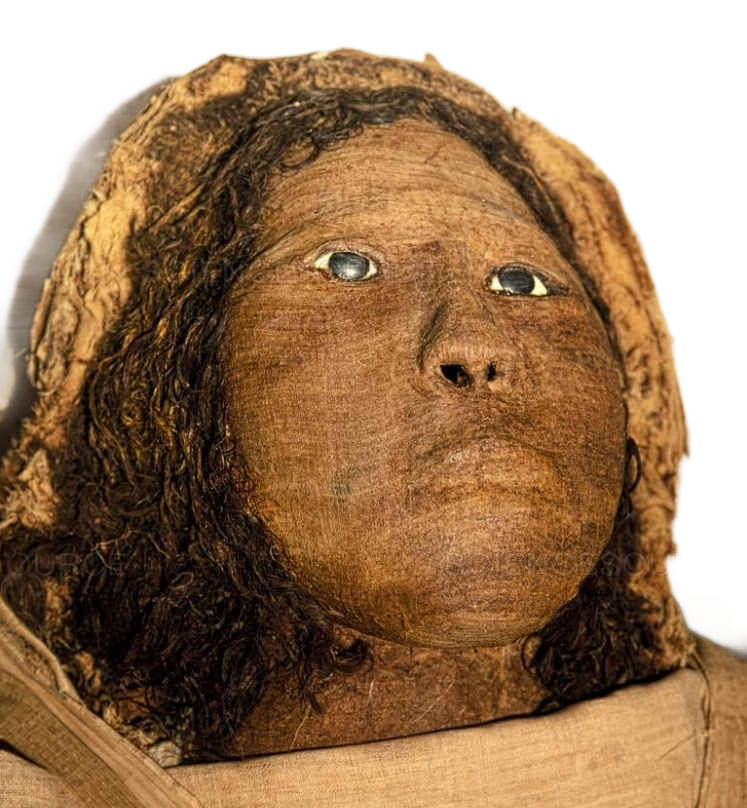
Maatkara
Photo: Patrick Landmann/Science Photo Library