
The mummy of Tayuheret
The mummy of Tayuheret (CG 61091, coffins CG 61032), probably the wife of the High Priest Masaharta, was unwrapped by Gaston Maspero on 29 June 1886. The resin-coated linen carapace covering her body was left largely intact. On 6 July 1909, G. E. Smith examined the mummy and discovered that the resin used to form this carapace had been mixed with sawdust, an ingredient Smith had not previously encountered in this context. He removed enough of the hardened linen to expose the face but was obliged to leave most of it in place to avoid causing damage.
Smith observed that Tayuheret’s cheeks had been packed to flesh them out. He does not specify the material used on this occasion but notes it was similar to that employed in the mummies of Maatkara and Henttawy A. Tayuheret’s nostrils had been covered with discs of wax, and a nose-guard fashioned from wax had been placed to prevent the nose from becoming flattened or distorted by the bandages. She was given a set of artificial stone eyes, and her right eye was also covered by a wax plate. Further, wax was used to fill the gap between her lips, which Smith described as being widely parted.
Tayuheret’s ears were covered with hair, which Smith believed consisted mostly of a wig. Her own hair was almost completely white, indicating she had died at an advanced age. Smith also noted that insects had damaged the skin of her face, particularly the forehead. This may suggest that an unusually long period separated Tayuheret’s death from her embalming. On the other hand, the bandages themselves also appear pitted with small holes (see photo below), possibly caused by insect activity post-embalming. Smith remarked that the plate used to close the embalming incision differed from the engraved examples usually employed during the 21st Dynasty, being plain and fusiform in shape, akin to those used by embalmers in the 18th Dynasty.
Tayuheret was discovered in a double coffin set originally made for a chantress of Amun named Hatet (CG 61032). The gilded hands and faces of both coffins were missing, and the inner coffin had sustained further damage; the head and feet of her coffin board were also absent. Reeves notes that only some broken shabti boxes survived from Tayuheret’s other funerary equipment. However, numerous shabtis inscribed for Tayuheret are preserved in both private collections and museums. Presumably from DB320, many of these shabtis were likely removed by the Abd el-Rassul family and subsequently sold on the antiquities market.
Source Bibliography: CCR, 171ff.; DRN, 203, 208, 214, 256; MR, 578, 590; RM, 105.
Original burial: unknown.
Reburials: Since the coffins and coffin board of Tayuheret were defaced in a manner similar to those of Masaharta and Maatkara, Reeves suggests that she was probably buried with them at some point prior to her reburial in DB 320. Edward Loring, however, interprets the damage differently, arguing that Tayuheret was not interred with her supposed husband Masaharta or with Maatkara, but was instead originally buried elsewhere. All three mummies were found in end chamber “F” of DB 320 prior to the caching of the Inhapi group of mummies. Reeves dates this latter event to sometime after Year 11 of Shoshenq I, DRN, 256; TIP, 457, table 9; TRC, 67f.
Source 2025-07: Edited from a now-defunct page of The Theban Royal Mummy Project via Wayback Machine
Source url: https://members.tripod.com/anubis4_2000/mummypages1/21A.htm

CG 61091
Tayuheret mummy in the Boulaq Museum
See The Royal Mummies (1912) by Smith
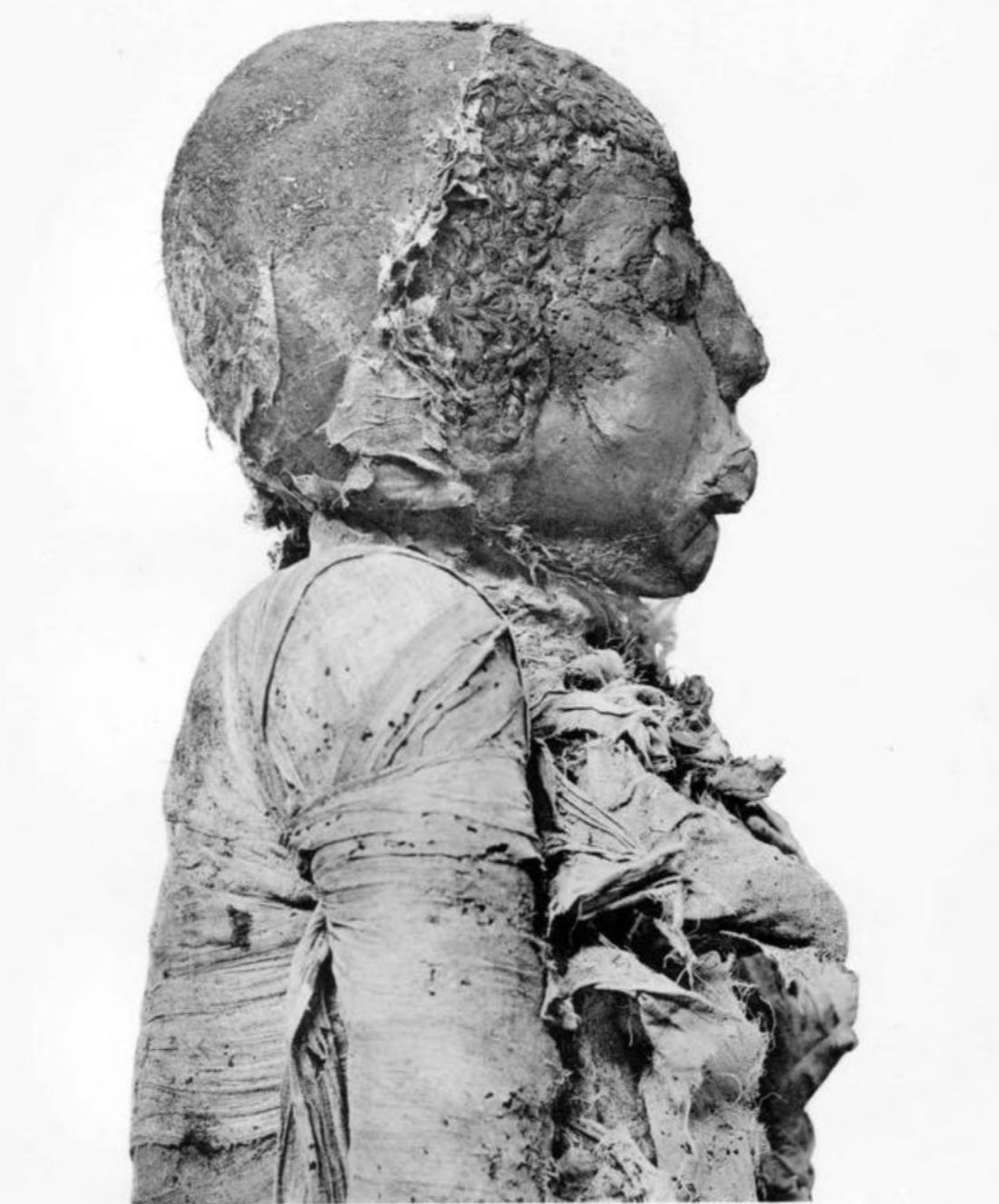
Tayuheret mummy in the Boulaq Museum
See The Royal Mummies (1912) by Smith