
Examples Book of the Dead Vignettes
This is an ambitious and fascinating learning project, which I hope to complete in 2026. I warmly welcome any suggestions, corrections, or comments along the way
For this study I assembled and examined a corpus of 55 papyri, 11 New Kingdom, 29 TIP, and 15 Late Period/Ptolemaic papyri, for the examples listed on this site. The pages with the vignettes are orginized in chronological sequence
Thematic Structure of the Late Period Sequence
The spell numbers follow Lepsius’s 1842 edition of the Turin papyrus of Iufankh. The thematic division into four parts with a supplement was proposed by Paul Barguet in 1967, and the subgroups reflect the clusters recognised in more recent scholarship
This sequence is a feature of the Late Period only. It first appears in manuscripts of the Twenty-sixth Dynasty and is therefore known as the Saite recension, although even there the order was only approximately fixed. In the New Kingdom and the Third Intermediate Period the Book of the Dead had no set order. Each papyrus presented an individual selection and arrangement, shaped by the owner’s means and by the traditions of the workshop that produced it
Spell 76 to 88 – Transformation Spells
Spell 110 – Being in the Field of Offerings
Spell 124 – Going down to the Tribunal of Osiris
Spell 125 / TG – Declaration of Innocence
Spell 126 – The Lake of Fire
Spell 144 to 147 – Passing through the Gates of the Duat
Spell 148 – Providing sustenance for the deceased
For photo credits, please consult the entry for the papyrus to which the vignette belongs on ushabtis.com
See for translations, analyses and academic information Totenbuch (Sprüche)
See for translations The Egyptian Book of the Dead:
Documents in the Oriental Institute Museum at the University of Chicago
See the publication by R. O. Faulkner, with its excellent illustrations and translations:
The Ancient Egyptian Book of the Dead, 1985 revised edition
Numbering of the Book of the Dead Spells on Wikipedia
N.B. The dates mentioned with the papyri are my own estimates based on my own reasearch and should be double-checked before use in academic work
Based on the available data, I have made an estimate for the TIP papyri, I have roughly used the following:
1075 BC – end/early 20th/21th
1050 BC – early 21th
1040 BC – early/middle 21th
1010 BC – middle 21th
0960 BC – late 21th
0945 BC – late/early 21th/22nd
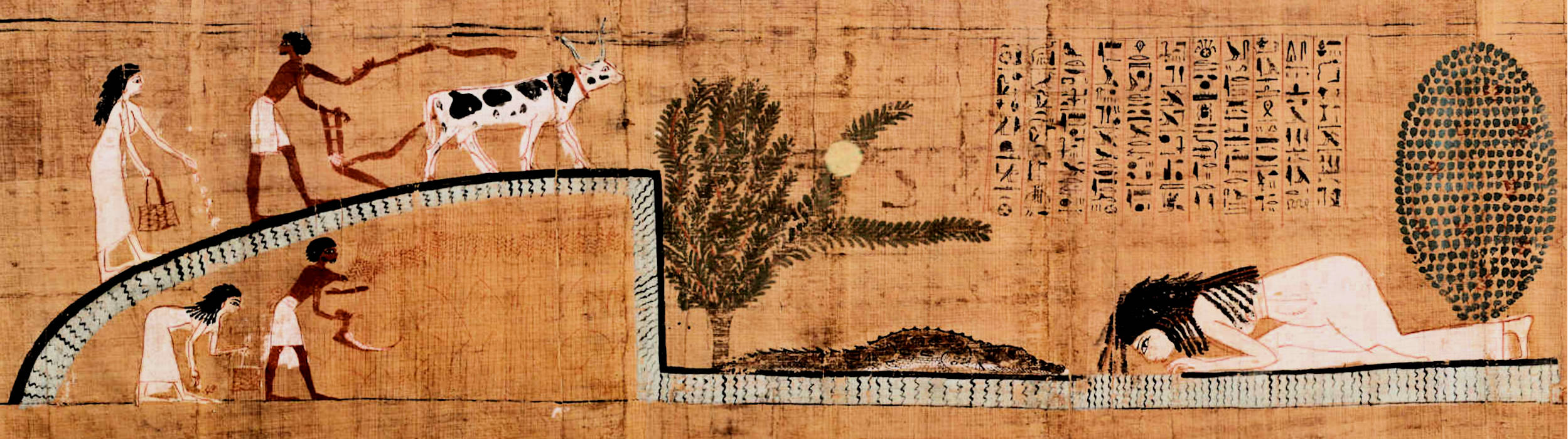
On this amazing vignette (unique Spell 100) we see Herytubekhet. Reading from right to left, Herytubekhet is first shown further along the canal, positioned between a sacred sycamore and a sacred shore tree, bowing deeply, lying flat on the ground directly at the water’s edge to drink. Resting immediately before her is a large crocodile. Far from a threat, this beast personifies Geb, the ancient Egyptian earth god, providing his foundational blessings over the fertile land. Moving leftward, in the upper register, she stands upright, scattering or sowing seeds from a basket into the freshly turned soil behind a man who is plowing with two spotted cows. Finally, on the left in the lower register (under the canal curve), she bends down to pick up grain from a pile, dropping it into a small basket, while following a man who is reaping the crop with a sickle
Photo: VB 2021
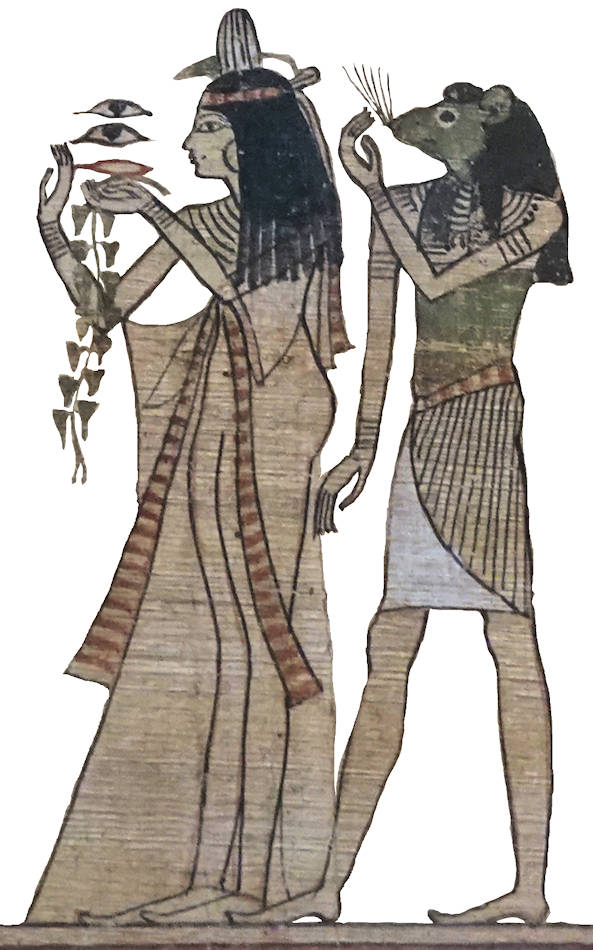
In the Egyptian afterlife, Taudjatra does not surrender her senses but proudly reclaims them. Empowered by Dodenboek magic, she safeguards her mouth and eyes, regaining her power to speak and see. The trailing flowers underscore ongoing renewal, ensuring her life force is eternally restored
Photo: VB 2024