
Vignettes Spell 125 / TG
The Declaration of Innocence
Structures the decisive post‑mortem judgement of the deceased in the Hall of Justice, securing admission to the afterlife as a vindicated being rather than annihilation. The vignette and text together stage a formal judicial procedure before Osiris in which the heart is weighed against the feather of maat, while a detailed confession of innocence and precise knowledge of the forty‑two divine judges establish the deceased’s moral and ritual qualification for continued existence among the gods
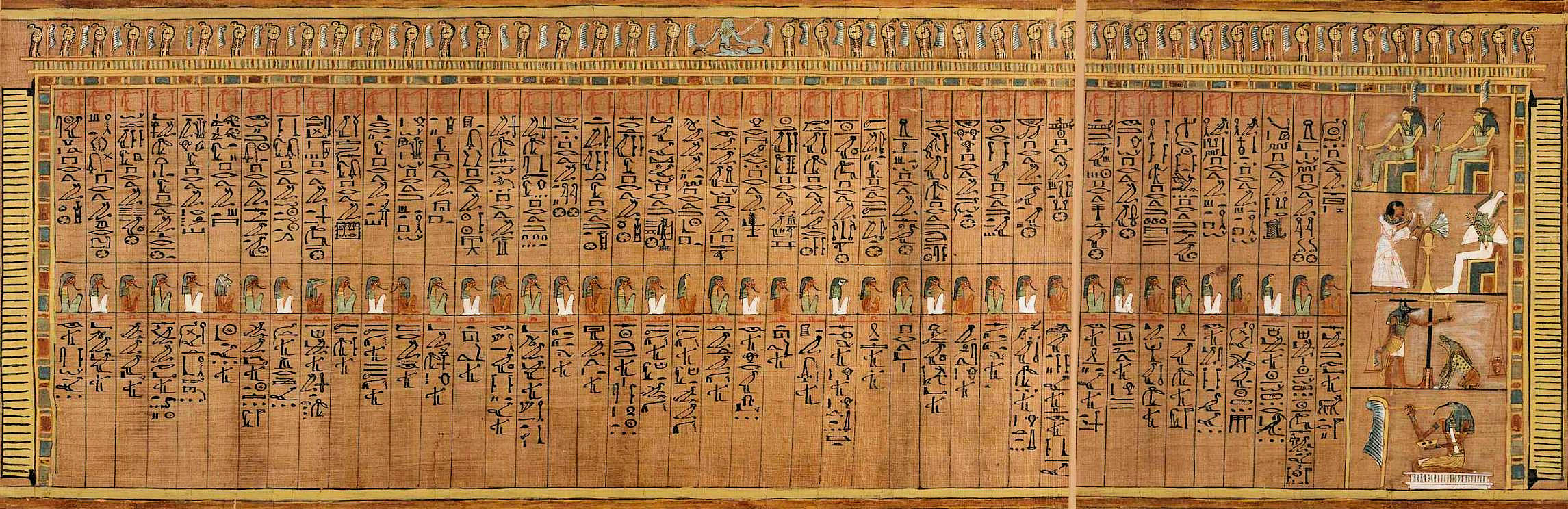
Spell 125 of the Book of the Dead shows significant variation in its visual and textual layout across different papyri. Although academically divided into three phases, the introduction (125A), the Negative Confession before the 42 judges (125B), the final interrogation and weighing of the heart (125C / TG), scribes adapted the accompanying vignettes based on space and patronage. Manuscripts like the Papyrus of Ani take a theatrical approach, showcasing a prominent weighing scale. Conversely, documents like the Papyrus of Nakht omit these dramatic scenes entirely, prioritising a structured, legalistic layout that focuses strictly on the 42 judges
N.B. While the vignettes with the weighing of the heart visually represent the Judgment scene, their accompanying texts cannot always be assigned to Spell 125. Depending on the papyrus, the columns may record independent heart spells (like Spell 30B), the formal speech of Thoth (Rede des Thot), or even non-canonical texts (Ausserordentliches Textgut). Following the strict textual classification of the Totenbuch database, these are logged by their specific texts rather than a generic Judgment label (TG), but they are included here for iconographic completeness
See for analyses and academic information Totenbuch Spruch 125 and Spruch TG
See for translations and plates R. O. Faulkner, The Ancient Egyptian Book of the Dead, 1985 revised edition, p.29ff.
“The Declaration of Innocense”
For the names of the judges 125B see “About the Judges of the Spell 125B of the Book of the Dead” by Radwa El-kemaly 2021

Ammit, the Eater of Souls from Ancient Egyptian mythology.
With the head of a crocodile and the body of a lion and hippo, she guarded the scales of justice, waiting to eat the hearts of the bad
Photo: Djoser papyrus VB 2021
Senuseret
Papyrus c. 1475 BC, 18th Dyn.
Photo VB 2022/2023


Maiherperi
Papyrus c. 1400 BC, 18th Dyn.
Photo VB 2021

On the left the introduction of Maiherperi (125A).
On the right the Negative Confession before the 42 judges (125B) in The Hall of Two Truths from top to bottom “[O name god/judge, place he is from, sitting god/judge], negative declaration”.
For example in the first column on the left, the first judge “O Wide of Stride who comes from Heliopolis, I have done no evil”


Nakht
Papyrus c. 1325 BC, 18th Dyn.
© The Trustees of the British Museum

Start Spell 125 A on the left of the vignette above
Hunefer
Papyrus c. 1290 BC, 19th Dyn.
© The Trustees of the British Museum


Amenemwia
Papyrus c. 1075 BC, 21th Dyn.
Photo BnF Gallica


Nodjemet
Papyrus c. 1070 BC, 21th Dyn.
Photo 125B Judges – VB 2023
Photo 125C Scale © The Trustees of the British Museum


Tajoeheryt
Papyrus c. 1050 BC, 21th Dyn.
Photo RMO Leiden

41 judges. The judge nb-Hrw “the Many-faced” is depicted three times in the same compartment but should be counted as one

Sutymes
Papyrus c. 1050 BC, 21th Dyn.
Photo BnF Gallica


Ankhefenamen
Papyrus c. 1040 BC, 21th Dyn.
© Dresdner Skulpturensammlung

See for an interesting opinion: Marc Gabolde, Une interprétation alternative de la “pesée du coeur“ du Livre des Morts, in: Égypte Afrique & Orient (2006). The weighing scene models real-world trade administration. The heart serves as a physical stone weight. The Spell 30B heart scarab acts as a magical “counterweight,” mechanically tipping the scales to guarantee a flawless divine accounting audit
Pinedjem I
Papyrus c. 1035 BC, 21th Dyn.
Photo VB 2021

Henuttawy-A
Papyrus c. 1010 BC, 21th Dyn.
Photo VB 2026-01


Khonsuenrenep
Papyrus c. 1010 BC, 21th Dyn.
Photo Mr. John M. Kelly (c) Field Museum of Natural History – CC BY-NC 4.0, VB photos available on request

Aaneru
Papyrus c. 1010 BC, 21th Dyn.
Photo Archivio Museo Egizio

Taudjatra
Papyrus c. 1010 BC, 21th Dyn.
Photo VB 2024

40 judges, the negative confession direcly under their name, below the judges in every register the name of Taudjatra


Tentimen
Papyrus c. 1010 BC, 21th Dyn.
Photo BnF Gallica


Bakenmut (I)
Papyrus c. 960 BC, 21th Dyn.
Photo VB 2021

41 judges, whose names alone are given; the negative confessions are omitted

Djedmutiuesankh
Papyrus c. 960 BC, 21th Dyn.
Photo VB 2022

Horemakhbit
Papyrus c. 945 BC, 21th Dyn.
Photo VB 2025

Taatum
Papyrus c. 350 BC, 30th Dyn.
Ägyptisches Museum Berlin

Imhotep
Papyrus c. 340 BC, Ptolemaic
Photo VB 2024

Padiamonnebnesouttaouy
Papyrus c. 280 BC, Ptolemaic
Photo BnF Gallica


Djoser
Papyrus c. 250 BC, Ptolemaic
Photo VB 2022

Pajuheru
Papyrus c. 250 BC, Ptolemaic
Photo Bayerische Staatsbibliothek

Neferini
Papyrus c. 225 BC, Ptolemaic
Photo VB 2022

Iuefankh
Papyrus c. 200 BC, Ptolemaic
Photo VB 2025

Keku
Papyrus c. 200 BC, Ptolemaic
Photo VB 2022

Taruma
Papyrus c. 200 BC, Ptolemaic
Photo VB 2023

Tasheritenkhonsu
Papyrus c. 200 BC, Ptolemaic
Photo Archivio Museo Egizio

Tayesnakht
Papyrus c. 200 BC, Ptolemaic
Photo Archivio Museo Egizio

Tarudj named Naynay
Papyrus c. 150 BC, Ptolemaic
Photo VB 2022

Anonymous
Papyrus c. 100 BC, Ptolemaic
Photo Wiki Commons
